 Nidalumi
Screen time for kids: rules you can actually agree on
Not "how many hours are allowed," but how to agree so the rule works without shouting. Ready-made wording, the order of the conversation, and what to do when you hear "five more minutes" for the tenth time.
I say "turn it off" and get "hang on, five more minutes." Half an hour later I'm yelling, he slams the door, and the evening is ruined for everyone. Next day, same thing.
The fight about screens is almost never about screens. It's about a rule that exists only in the adult's head and gets announced while the kid is mid-game. To them that's not a rule, it's a sudden "no." Below is how to make the rule known ahead of time, shared, and independent of your mood.
First, three decisions for the adults
Before talking to your kid, the adults need to agree among themselves. If Mom has one rule and Dad has another, the kid will pick the convenient one.
- What counts as a screen. Games and videos, yes. What about homework on a tablet? A call with Grandma? Music? Name what's in and what's out.
- What isn't up for discussion. Two or three things the adults decide: for example, when screens end in the evening and what's off-limits to watch.
- What your kid chooses. What to spend their time on, in which part of the day, who to play with. The more real choice there is here, the fewer fights over the limits.
The American Academy of Pediatrics suggests writing a family media plan together: when, where and how screens are used at home.
How to work it out together with your kid
Pick a calm moment, not an evening when you've just fought about the phone.
- Name the goal without blame. "We fight about the phone every night. I don't like it, and neither do you. Let's come up with rules so we don't fight."
- Ask first. "What rules do you think would be fair?" Sometimes kids propose stricter ones than the adults had in mind.
- Name what isn't up for discussion. Briefly, no lecture.
- Agree on the rest. When, where, what, and what happens if a rule is broken. More on that below.
- Write it down. On paper, in your kid's own words, and put it somewhere visible. A rule on paper is no longer "because Mom said so."
- Set a review date. "Let's try it for two weeks, then talk about what to change." That takes away the feeling of a life sentence.
Ready-made wording for rules
Take the ones that fit and fill in your own times and places. Five to seven rules are enough: nobody remembers a long list.
| About | Wording |
|---|---|
| Order | "First the tasks on the list, then screens. The list is known from the morning" |
| When | "On school days, screens are after homework and before dinner. On weekends, in the morning and after lunch" |
| End of day | "At ___ screens are over. The phone sleeps on the charger in the hallway" |
| Meals | "No phones at the table, for kids or for adults" |
| Starting | "Before you turn it on, you say what and for how long" |
| Timer | "Whoever is watching sets the timer. When it goes off, you finish the episode or play to the next save point, and that's it" |
| Warning | "An adult gives one heads-up, ten minutes before the end" |
| Schoolwork | "Homework on a screen doesn't count as play time, but no playing during homework either" |
| New stuff | "You show a new game or app to an adult first" |
| Visits and travel | "On the road and at other people's houses the rules are different, and we agree on them before leaving home" |
Two rules in the table deserve a closer look.
"For kids or for adults." A rule the adults don't follow themselves strikes a kid as unfair, and the kid is right. Even one rule that applies to everyone makes the rest more convincing.
"Play to the next save point." Cutting off a game mid-level is, for a kid, like switching off a movie a minute before the end. Agreeing on a clear stopping point removes most of the "just a little longer."
What to do when a rule is broken
The consequence is named in advance, in the same conversation, and written down next to the rules. Then it isn't a punishment dealt in the heat of the moment. It's part of the deal.
A good consequence is:
- tied to screens, not to playing outside, dessert, or a friend's birthday party;
- short: it's about tomorrow, not "no phone for a month";
- doable: one you'll really follow through on;
- lecture-free: one sentence, and that's it.
Sample wording:
- "Didn't turn it off at the timer: that much less screen time tomorrow."
- "Picked up the phone before the tasks: screens are over for today."
- "The phone ended up in the bedroom at night: next night it stays with the adults."
What to say in the moment: "The timer went off ten minutes ago. By our rule, that's ten minutes less tomorrow." And walk away. Don't argue, don't explain it all again, don't raise the stakes.
If one rule is broken all the time, it's most likely badly designed. Bring it to the review: what gets in the way of following it, and how to rework it.
How to link screens to chores without haggling
The "tasks, then screens" link works until it becomes a bazaar: "what if I vacuum too, do I get an hour?" To keep that from happening:
- The task list is fixed and known ahead. It isn't made up on the spot, and it doesn't grow once your kid has already sat down to play.
- "First, then," not "if, then." "First homework and backpack, then screens" is the order of the day. "If you clean up, I'll let you play" is a transaction, and soon your kid will be the one setting the price.
- "Done" means the same thing every time. Agree on what "cleaned your room" means: clothes in the closet, desk clear, nothing on the floor. Otherwise the argument just moves here.
- The adult checks once. Looked, confirmed, screens are open. No "oh fine, you'll finish it later."
- Extra time only at a rate named in advance. If jobs beyond the usual ones can earn more screen time, the price is set ahead and isn't negotiated in the moment.
- Personal basics aren't paid for in screen time. Brushing teeth and packing a backpack are just life. How to reward jobs beyond the usual ones is on the page about points and rewards.
Where this can live instead of in your head
The most tiring part of this system is remembering: did he do his tasks, how much has he earned, did he already ask today. In Nidalumi, the list holds that part. Your kid has their tasks with a Done button; a parent sees them in "Waiting for your check" and confirms. Tasks earn points, and points are traded for rewards. Screen time works as a request: the kid asks, the parent allows it; the section is turned on in settings.
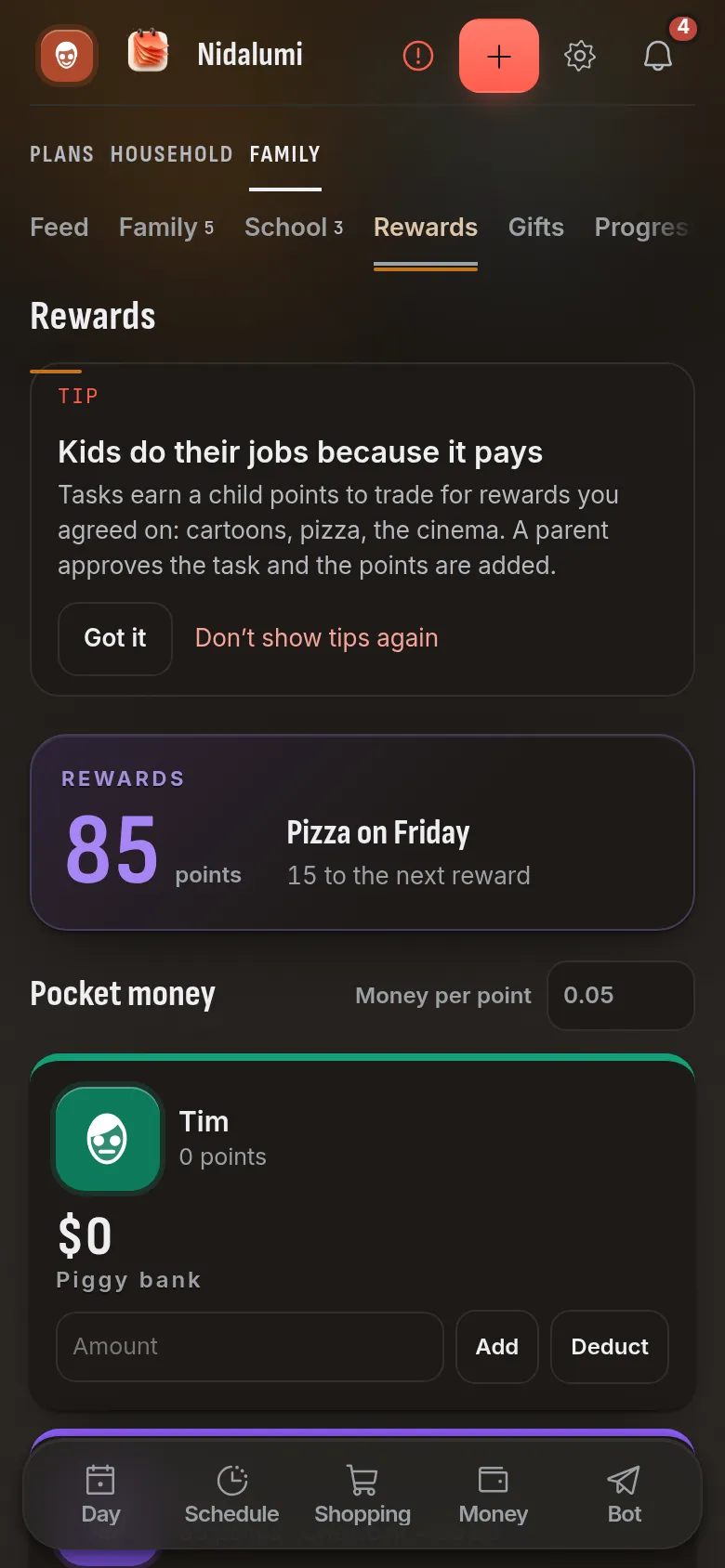
You'll still have to do the agreeing in words, at the table. But after that there's nothing to argue about: done or not is visible on the screen, not settled in a shouting match. To fit screens into the order of the day, see the daily routine for a school-age kid.
How it works in Nidalumi: Kids' Schedule.
Questions and answers
How many hours a day is okay for a kid?
We don't give a single number: it depends on age, health and how your family lives. Questions about limits are best taken to a doctor. Whatever number you choose, it will only work if you agreed on it in advance.
My kid won't agree to any rules. What do I do?
Start with one rule that applies to everyone, adults included, like meals without phones. And give real choice where it's possible: what time of day, what to spend it on. Rules that include their own decision get followed more willingly.
The rules get broken every day. Is this a failure?
It's a sign that a specific rule is badly designed: the end lands in the middle of a game, there are too many tasks before screens, or the consequence never happens. Rework that one rule without scrapping the rest.
Can I give screen time for good grades?
That's the family's call. If yes, name the terms in advance and keep it separate from regular time, so a rough week at school doesn't turn into an argument every evening.
Does this work with a teenager too?
The order is the same, but with more room for their decisions and fewer checks. What matters most to a teenager is that rules are discussed with them, not announced. The limits that aren't up for discussion remain; there are just fewer of them.
Sources
How this guide was made: written by Christopher Clark, who builds Nidalumi. Figures and health or money facts are checked against the sources listed in the guide. We update it when the advice changes.