 Nidalumi
Teenagers and chores: how to reach a deal
Not forcing, but agreeing: their own turf, a deadline instead of "now," and a reminder that isn't your voice. Below is a ready-made order for the conversation, a list of chores, and phrases.
I ask him to clear the table for the fifth time. He says "in a sec." An hour later I'm yelling, he slams the door, and the dishes are still sitting there. So I wash them myself, mad at the whole world.
A familiar loop: request, "in a sec," reminder, yelling, door. Nobody in it is the bad guy. The setup itself is badly built. The job stays yours, and the teenager gets the role of someone who acts on command. At this age, commands are hard for almost everyone.
The short answer: five points of the deal
- Their own turf, not help. A few jobs that belong to the teenager completely.
- A "by" deadline, not "now." "By eight tonight," not "immediately."
- It's clear what "done" means. In one sentence, in advance.
- The reminder isn't your voice. A note, an alarm, a message on their phone: anything except the fifth repeat.
- What happens if it isn't done is known in advance. Calmly, with no improvising in the middle of a fight.
Next: how to put each point together.
Why "just ask" doesn't work
The request lands at the wrong moment. "Take out the trash" arrives in the middle of a game, a chat or homework. "In a sec" here isn't a no. It's "not this second." But "in a sec" has no deadline, so it stretches until evening.
The job stays yours. Noticing, deciding when, and reminding are all still on you. The teenager only got the doing. Work like that is hard to see as your own, for adults too.
The reminder sounds like control. The more often it's repeated, the less it's heard. By the fifth time it's not information anymore, it's background noise.
It's unclear what's enough. "Clean your room" means floors and dusting to you, and moving clothes off the chair to them. Both of you are sure you're right.
None of these is fixed by strictness. Each is fixed by the setup.
What you can hand over to a teenager completely
Completely means they keep track, they decide when within the deadline, and they do it. These are examples, not a standard: choose by what they can manage and by their school schedule.
| Turf | What it includes | Deadline |
|---|---|---|
| Their own laundry | Gather, start the load, dry, put away in the closet | By Sunday evening |
| Trash | Watch the bin, take it out, put in a new bag | By 8:00 p.m. on their days |
| Dishes after dinner | Load the dishwasher or wash, wipe the table | Before bed |
| The pet | Food, water, a walk or the litter box | Morning and evening |
| One dinner a week | Pick the dish, add the ingredients to the shopping list, cook | On their day |
| Their room | The agreed minimum (see below) | By Saturday |
| A younger brother or sister | Pick them up from practice on their day | Per the schedule |
Two or three to start with is enough. The full rundown by age is in the list of chores for kids by age.
How to have the conversation
Pick the time. Not in the middle of a fight and not standing over a dirty plate. Better over a meal or in the car, when nobody's in a rush.
Start with the full list. Show what gets done at home and by whom. Not as blame, as a map. Teenagers often truly don't know how much there is.
Let them choose. "Here are the jobs that are up for grabs. Which two or three are yours?" What they picked gets done more willingly than what was assigned.
Name the deadline and the minimum. For each job: "by what time" and "what counts as finished."
Agree on the reminder. Ask straight out: "How should you be reminded so that it's not my voice?"
Talk through what happens if the job isn't done. What works best is whatever follows from the job itself: didn't do laundry, no clean T-shirt; didn't take it out, takes it out before sitting down to game. Not a punishment made up in anger, but a condition known in advance.
Set a review. In two weeks: what worked, what to change.
A teenager's room is a separate deal
The room causes the most fights because it's both their territory and part of the shared home. A workable option is to split it:
- A shared minimum you agreed on: food and dishes don't pile up in the room, dirty clothes go in the hamper, the floor gets done once a week.
- Everything else is their business. Clothes on the chair, the state of the desk, the posters.
The minimum is checked on the agreed day, not whenever the door happens to open.
Should you pay for chores?
Families decide this differently, and both routes work. What matters is picking one and not switching midway.
- Basic chores are unpaid, because everyone lives in this house. Extras are paid: washing the car, clearing out the garage.
- Points for everything, later traded for a reward or allowance money at a rate known in advance.
How to build this without haggling over every plate is in the guide to allowance.
If the deal didn't work
Go through this list before going back to yelling:
- Was the deadline a specific time, or the word "later"?
- Do you both understand the minimum the same way?
- Was there a reminder, or were you counting on memory?
- Are there too many jobs for a week full of tests?
- Did someone do the job for them "because it's faster"?
That last one is the most common. A job done for a teenager stops being theirs by the second time.
When the phone does the reminding, not you
In Nidalumi, a teenager has their own role and their own tasks. The reminder goes to them, in Telegram or as a notification on their phone, with Done and Postpone buttons. Postpone matters here: it's a legitimate way to say "not now" without "in a sec" and without an argument. Take-turns jobs are handled by a rotation: it passes the job to the next person automatically, and you can swap.
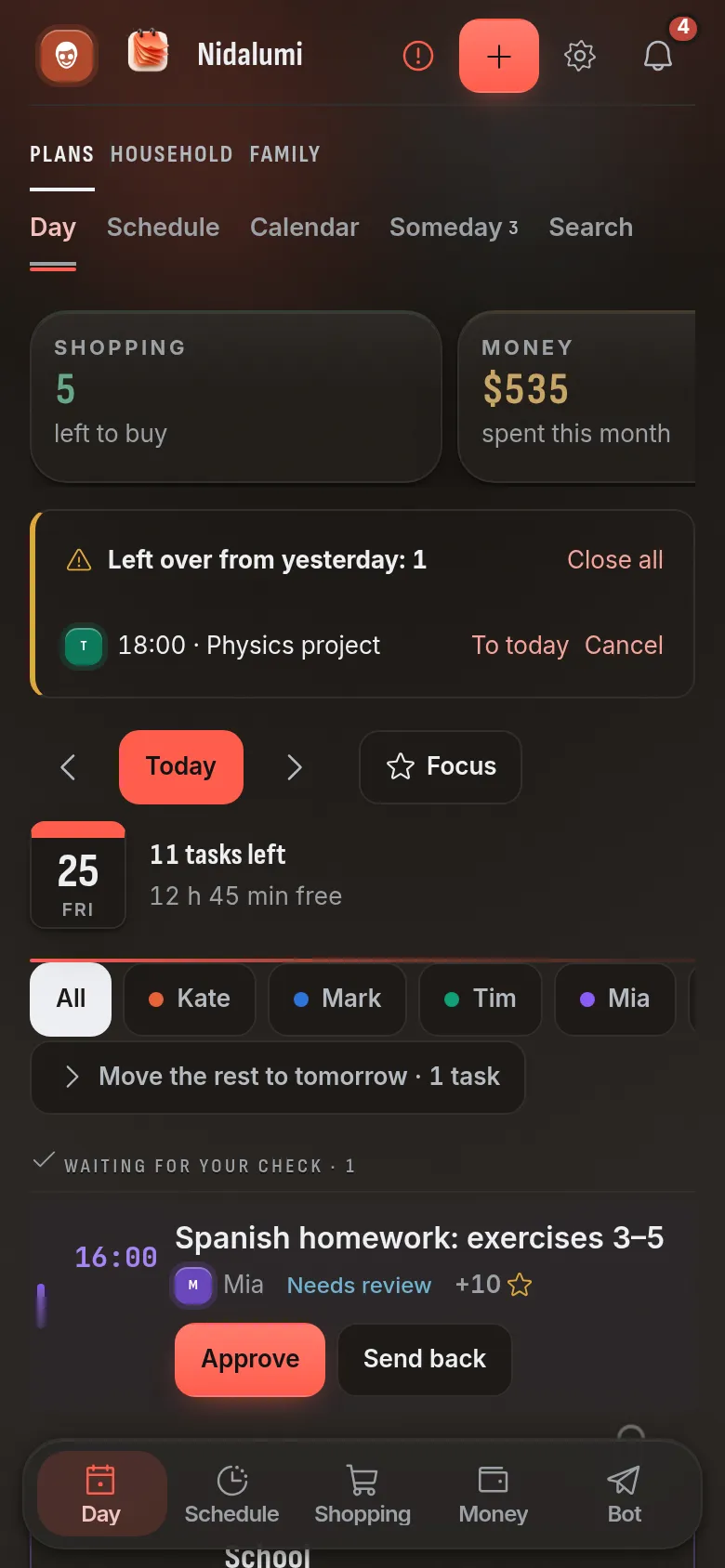
In the evening there's a daily summary: what got done and what didn't. There's no need to ask "did you do it?" because it's right there. And the complaint "Mom's on my case again" fades by itself: the phone did the reminding, under a rule everyone agreed to.
How it works in Nidalumi: Chore Points and Rewards.
Questions and answers
At what age should a teenager have regular chores?
Small jobs of their own are useful long before the teenage years. By twelve or thirteen, whole areas are usually manageable: their own laundry, trash, dishes after dinner, pet care.
What if my teenager agreed but doesn't do it?
Don't remind for the fifth time and don't do it for them. Let the agreed condition kick in, and come back to the conversation at the review: maybe the deadline is inconvenient or there are too many jobs.
Is it okay to take away the phone over undone chores?
That's the family's decision. A condition works better when it's named in advance and tied to the job, not invented in the middle of a fight. "Trash first, then the game" is clearer than "that's it, no phone for a week."
Do I need to check how it was done?
Check the agreed minimum, yes, once, at the agreed time. Anything above the minimum is their way of doing it, and it's best left without comment.
There's a ton of homework. Should chores be dropped?
During tests or finals, chores can be cut back or moved, by agreement and not silently. It's usually worth keeping one or two regular ones.
How this guide was made: written by Christopher Clark, who builds Nidalumi. We update it when the advice changes.