 Nidalumi
Points and rewards for chores: motivation without yelling
Your kid does it, checks it off, earns points, and trades them for something they picked. Below is a ready-made sample of chores and rewards, plus five rules without which any reward chart stops working.
The kids won't check anything off. They won't even do the dishes without a fight, and now they're supposed to tap something on a phone?
They will, if the button stands for something. A sticker chart on the fridge usually breaks in three places: it's unclear what exactly earns a star; the adults forget to draw it; and the reward is so far off that the kid stops believing in it. All of that can be fixed in one evening.
Build the system: two lists
Chores and what they're worth
| Chore | Points |
|---|---|
| Make the bed | 1 |
| Pack the backpack the night before | 2 |
| Feed the cat | 2 |
| Do the dishes after dinner | 3 |
| Vacuum their own room | 5 |
The numbers here are only an example. What matters is the ratio: longer and harder means worth more. For which chores suit which age, see the list of chores by age.
Rewards and what they cost
| Reward | Price in points |
|---|---|
| Pick the movie for family movie night | 10 |
| Favorite meal for dinner | 15 |
| A trip to the movies | 60 |
| Allowance money | at a rate the parent sets |
| A big goal, like a scooter or a building set | saved up gradually |
Put the reward list together with your kid. A reward the adults came up with is often worth nothing to them.
Five rules that keep the system from falling apart
- "Done" is defined in advance. Not "clean your room" but "clothes in the closet, nothing on the floor, bed made." Otherwise every evening is an argument about quality.
- Points arrive the same day. Did it today, saw it today. "Later, when I remember" kills interest faster than anything.
- One reward is reachable within a week. If everything takes a month of saving, your kid won't make it to the first reward. You need a near goal and a big one.
- Earned stays earned. If points can be lost to an adult's bad mood, there's no reason to save them.
- Prices don't change retroactively. The parent sets the rate and the cost of rewards, but new rules apply from tomorrow, not to what's already been earned.
How it works in Nidalumi
In Nidalumi, points are attached to tasks, and nobody has to count them by hand.
- Your kid sees their task and a Done button. The reminder goes to them, not through you.
- A parent checks it. A checked-off task lands in "Waiting for your check." Looking and confirming is one tap, with no "are you sure you cleaned up?" interrogation.
- Points are awarded for the task. Your kid sees how many they've saved up.
- Points are traded for rewards or allowance money. The parent sets the rate.
- A savings goal. A big item can be saved for gradually, and you can see how much is there so far.
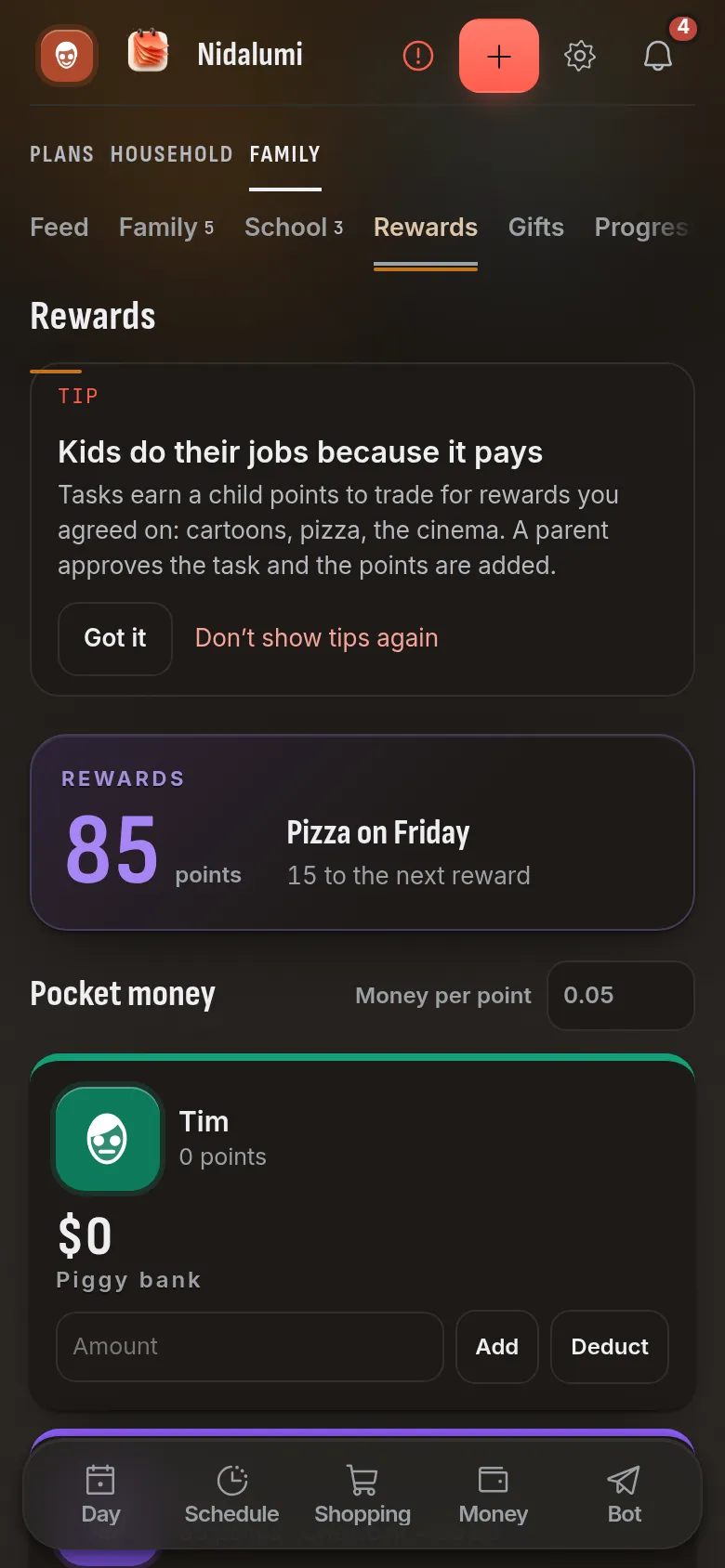
For a little one who doesn't have a phone, a parent checks off the task, and the points still go to the kid. Roles in a family differ (parent, adult, teen, child), and each has its own permissions.
Why this means less yelling
The "you didn't clean up / yes I did" argument happens when nothing records what was done and what was promised for it. Here both are recorded: the task, the check mark, the review, the points. The phone does the reminding, not Mom for the fifth time, and a reminder carries no personal grievance.
Promising that your kid will start cleaning up without a single word would be dishonest. But the conversation changes: instead of "how many times do I have to say it," it's "you have three tasks today and twenty points to go until the movies."
If points are tied to money, agree on the rules in advance. There's a separate guide about allowance.
Using FamilyWall for chores? See the FamilyWall alternative with points for kids.
Questions and answers
What age does a points system work from?
From the moment a kid understands the link "did it, got it." A phone isn't required: a parent checks off tasks for a little one, and you can look at the points and rewards together.
Do points have to be traded for money?
No, that's the family's call. Points can be traded for rewards or for allowance money; the parent sets the rate.
What if my kid checks off a task without doing it?
A task a kid checks off waits for a parent's review. Points appear for a confirmed task, so there's no point in tapping Done for nothing.
My kid will get bored in two weeks. Then what?
It usually gets boring when rewards are far off or never change. Every couple of weeks, refresh the list together with your kid and keep at least one near goal on it.