 Nidalumi
Daily routine for school kids: a sample schedule by the hour
Two weekday charts — one for an elementary schooler, one for middle school. Take them as a draft and shift things to fit your start time, commute and activities.
Every evening it's the same: "Homework done? Backpack packed? Gym clothes out?" I'm not a mom anymore, I'm an alarm clock with a voice.
A routine isn't there for discipline's sake. It's there so your child's day stops running on your reminders: when it's clear what comes after what, half the questions never need asking.
Below are two ready-made weekday examples. They're examples, not standards. Wake-up, school and sleep times are different in every family. How much sleep your child needs and how much they can take on is a question for the pediatrician, not for a chart from the internet.
Elementary school: grades 1–4, morning start
| Time | What happens | Who runs it |
|---|---|---|
| 7:00 | Up, wash, get dressed — clothes laid out the night before | The child, an adult nearby |
| 7:20 | Breakfast | An adult |
| 7:40 | Out the door | Together |
| 8:00–2:30 | School | — |
| 3:00 | Snack and rest: no homework and no grilling about grades | The child |
| 3:30 | Outdoor time or an activity | Per the activity schedule |
| 4:30 | Homework, with short breaks | The child, an adult on call |
| 5:30 | Free time | The child |
| 6:30 | Dinner | The family |
| 7:00 | One household chore and the backpack for tomorrow | The child |
| 7:30 | Games, reading, time together | The family |
| 8:30 | Shower, pajamas, a book | The child |
| 9:00 | Sleep | — |
Middle school: grades 5–8, morning start
| Time | What happens | Who runs it |
|---|---|---|
| 7:00 | Up to their own alarm | The child |
| 7:20 | Breakfast | The child or an adult — as agreed |
| 7:40 | Out the door | The child |
| 8:00–3:00 | School | — |
| 3:30 | Snack and rest | The child |
| 4:00 | Practice, an activity or outdoor time | Per the activity schedule |
| 5:30 | Homework | The child |
| 7:00 | Dinner | The family |
| 7:30 | Their household chore; backpack and clothes for tomorrow | The child |
| 8:00 | Free time | The child |
| 9:30 | Phone on the charger, shower | The child |
| 10:00 | Sleep | — |
What matters in these charts
Not the hours. You'll move those anyway. What matters is three anchor points that sit in the same place every weekday:
- Wake-up. The same time, with room for getting ready calmly.
- Homework start. Not "sometime this evening" but a specific hour. It's easier to sit down when it isn't up for debate every single day.
- Getting ready for tomorrow. Backpack, gym clothes, outfit — the evening before and ahead of free time, not instead of sleep. That's also how the morning goes without ten reminders.
Everything in between is flexible. One more thing: free time has its own line in the chart, not "if there's time left." A routine made of nothing but duties feels like someone else's to a child — and you can see why.
The American Academy of Sleep Medicine recommends 9–12 hours of sleep a day for children aged 6–12 and 8–10 hours for teens aged 13–18.
How to fit it to your family
A late start or an afternoon schedule
The day flips, but the three anchors stay:
- Morning: wake-up, breakfast and homework — before school, while nobody's tired yet.
- Before leaving: lunch and an hour with nothing to do.
- After school: dinner, free time, getting ready for tomorrow. Better not to leave homework for late evening — after a late school day there's usually no energy left for it.
- Activities: mornings or weekends.
Activities and sports
Put them in first: their times are fixed, and everything else fits around them. On a practice day homework can be split — some before, some after — or free time can be shortened. Don't touch sleep.
Don't add a big household chore on an activity day. And if the days are very different, don't try to squeeze them into one routine. Make two or three: "a regular day," "a practice day," "a music day."
After-school program
If homework gets done at the after-school program, the "homework" block at home shrinks to fifteen minutes: show what's done and finish the leftovers. The time that frees up is free time, not an opening for extra assignments.
The commute
Count back from the bell: class at 8:00, a twenty-five-minute trip, so you leave at 7:30, not 7:40. A chart that doesn't count the commute falls apart on the very first morning.
When the routine won't stick
The cause is usually one of four.
It was made without the child. Sit down together. Let them choose what comes first — outdoor time or homework — and where their free hour goes. What they chose is easier to keep than what was handed down.
It exists only in your head. Then it's not a routine, it's your reminders on a timetable. It has to live where your child can see it without you — and call out to them, not to you.
There's no slack in it. The day is scheduled back to back, and any delay wrecks everything until evening. Leave ten minutes between blocks.
One day broke, so the whole thing got dropped. Illness, guests, a big test. No need to make it up: tomorrow the day starts from the same three anchors again.
If your child can't keep up for weeks, is noticeably tired or has trouble falling asleep, don't tighten the routine. That's one for the doctor: a chart doesn't solve it.
How to keep the routine going without reminding out loud
In Nidalumi the weekly schedule is built by day and hour: school, activities, sports. Regular things are marked "Every week," one-offs "this week only"; for days that repeat there are day templates.
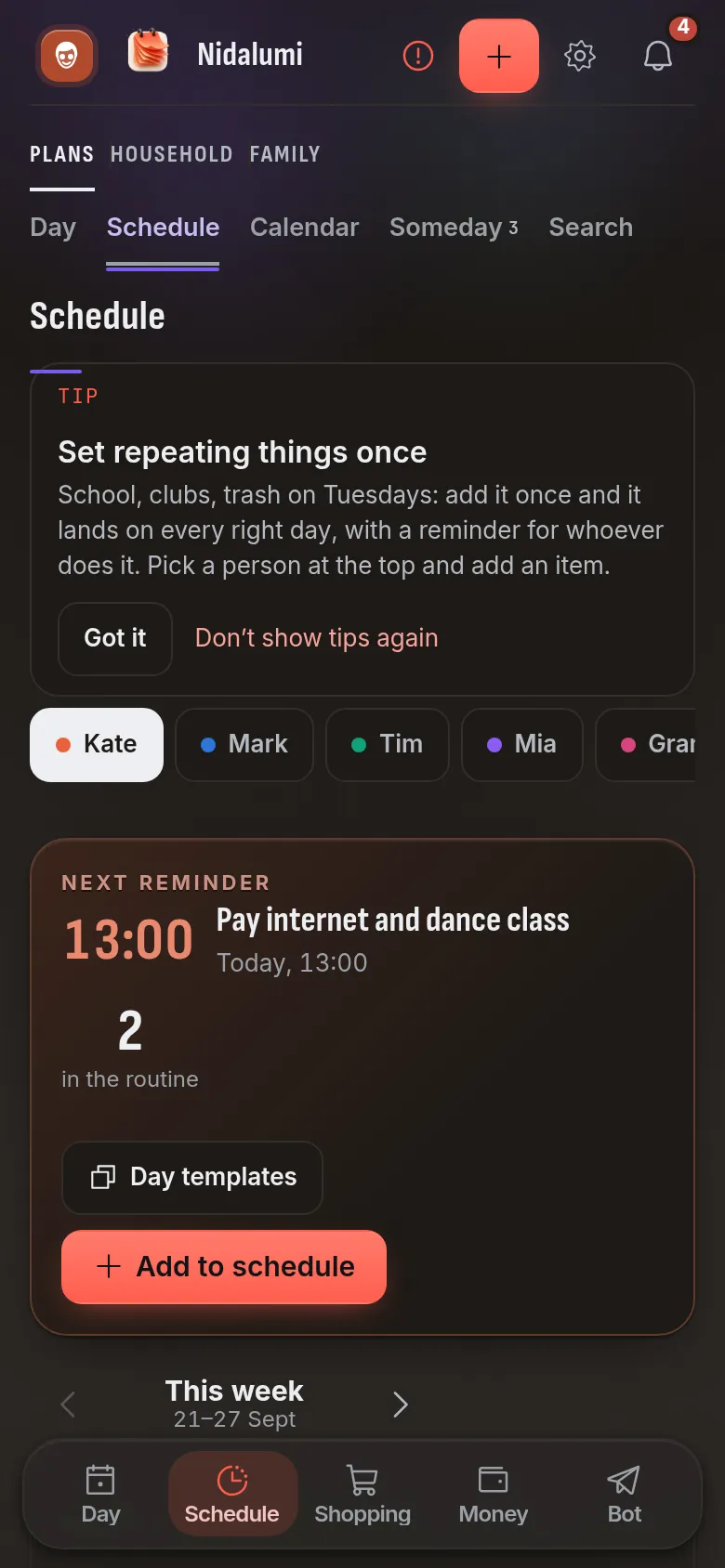
Anything your child actually has to do — homework, the backpack, their chore — is set up as a task. The reminder goes to them, in Telegram or as a notification on their phone, and the task has a "Done" button. For a small child without a phone, a parent marks it. In the evening a summary of the day arrives: what got done, what didn't. No need to ask "did you pack your backpack?" — you can see. More on the kids' schedule page.
Choosing a family app? Compare the best Cozi alternatives side by side.
Questions and answers
What time should a school-age child go to bed?
There's no single hour: it depends on age, wake-up time and the child. The bedtimes in the charts are examples. If you're not sure your child is getting enough sleep, ask the pediatrician.
When is the best time for homework — right after school or in the evening?
Start with "after a snack and a rest, before free time." If that doesn't work, try something else and compare after a week. The hour itself matters less than it being the same every day.
Do we need a routine on weekends?
A strict one, no. A couple of anchors will do: when we get up, and when on Sunday we get ready for Monday — backpack, gym clothes, the week's schedule.
What if my child doesn't want to live by a schedule?
Let them choose part of it: the order of things after school, when their free hour is. And take your voice out of the routine — let a list on the wall or the phone do the reminding, not you.
How do I build a routine if activities are different every day?
Not one routine but several templates: a regular day and an activity day. The three anchors — wake-up, homework start, getting ready for tomorrow — stay put in each.
Sources
How this guide was made: written by Christopher Clark, who builds Nidalumi. Figures and health or money facts are checked against the sources listed in the guide. We update it when the advice changes.