 Nidalumi
Allowance: how much, how often, and what for
There's no ready-made amount "by age," but you can work out your own in one evening. Below are three approaches, a calculation based on your kid's real spending, and rules that end the daily "can I have a dollar for a snack?"
On Monday I gave her money for the week. By Tuesday it was already "Mom, can I have some for a snack?" If I give it, the rules mean nothing. If I don't, my kid goes hungry. Every single week.
An allowance doesn't break over the amount. It breaks because the rules were never said out loud: what it's given for, when, what it can be spent on, and what happens if it runs out early. So first comes the main choice, then the amount, then the rules.
Three approaches: no strings, for chores, or mixed
| No strings | For chores | Mixed | |
|---|---|---|---|
| How it works | The same amount on the same day. It doesn't depend on anything | Money only for chores that got done | A fixed part always, plus extra for jobs beyond the usual ones |
| Pros | The amount is known ahead, so it can be planned. No haggling, no tallying | The link "did it, got paid" is visible. There's a reason to pick up a chore | The essentials don't depend on how the week went, and there's a way to earn money for wants |
| Cons | No link to effort: "I get it anyway" | Every request turns into "how much will you pay?" In a bad week there's nothing left even for a snack | You have to draw a clear line, once, between regular chores and paid ones |
| When it fits | The main goal is learning to manage money | Adults pay for the essentials (food, bus fare), and the allowance is only for wants | You want both planning and a clear reason to pitch in |
How to separate chores from money in the mixed approach
A split into three buckets that works:
- Your own stuff: unpaid. Cleaning up after yourself, making your bed, packing your backpack. That's not work, that's living in a house.
- Shared stuff: unpaid, taking turns. Dishes, trash, setting the table. Everyone who lives here does these.
- Beyond the usual: can be paid. Washing the car, clearing out the garage, watching a younger sibling while the adults are busy.
Then "how much will you pay?" in response to taking out the trash gets a simple answer: "That's a shared one. Paid jobs are on this list." For what a kid can handle at what age, see the list of chores by age.
How to pick the amount without "what do other kids get"
A number pulled out of thin air either covers nothing, or covers everything and teaches nothing. It's easier to start from what your kid already spends.
- Write down their spending in a normal week. A snack at school, bus fare, a drink after practice, little things at the corner store. Can't remember? Spend a week noting every "dollar for a snack" you hand out.
- Decide which of those move over to them. Next to each line, write "pays themselves" or "we pay." Lunch might stay with the adults while snacks and small stuff move to your kid.
- Add up what moved over. That's the required part: without it they'd have no bus fare.
- Add a free part. A small amount on top that can be spent on anything or saved. Without it there's nothing to choose between: all the money is already spoken for.
- Test it on yourselves. If that amount every week is uncomfortable for your budget, shrink the list from step 2, not the free part.
| Expense | Times per week | Who pays |
|---|---|---|
| Snack at school | them | |
| Bus fare | them | |
| Lunch | adults | |
| Drink after practice | them | |
| Free part | once | — |
You can redraw the table on paper and fill it in together with your kid. That way the amount stops being "they didn't give me enough" and becomes a calculation they watched happen.
The US Consumer Financial Protection Bureau’s Money as You Grow describes money skills age by age — a handy guide when deciding what the allowance should cover.
What age to start
Rather than the number on the birth certificate, look for three signs:
- your kid can count within the amounts they'll be getting;
- they have somewhere to spend without an adult: the school cafeteria, a store on the way home;
- they understand that money runs out, and the next batch comes on a known day.
It usually all comes together around the start of elementary school. After that the principle stays the same; what changes is the interval and the scope:
| Stage | How often | What it covers |
|---|---|---|
| Elementary school | once a week | snacks and small stuff |
| Middle school | once a week or every two weeks | plus bus fare, small purchases for themselves |
| Teenager | once a month | plus the phone plan, entertainment, some of their clothes, as agreed |
The older the kid, the longer the interval: a week is easier to plan than a month.
Rules worth agreeing on up front
Ten minutes of conversation before the first payout saves months of arguing. Go through the list and write down the answers:
- Payday. The same one every time. Not "when I remember" and not "when you ask."
- What this money buys. The list from the calculation above.
- What can't be bought at all. A short list of no-gos, named in advance, not after the purchase.
- What happens if it runs out early. No top-ups before payday; the essentials (food packed from home) are still there.
- Whether they can get an advance. If yes, how much, and how it gets paid back.
- Lost it, or lent it to a friend. Who covers that.
- Money from Grandma and for birthdays. Whether it's all theirs, or part goes toward a shared goal.
- Whether allowance is tied to grades and behavior. Decide once. If the money can vanish at any moment, it can't be planned.
- When the amount gets reviewed. For example, at the start of the school year and whenever the spending list changes.
Common mistakes
- Paying whenever. No payday means no planning, just "ask for more."
- Topping it up. Every "last time" top-up says the amount doesn't mean anything.
- Picking apart every purchase. A silly purchase with their own money is the cheapest lesson there is. No-gos come as a list, in advance; the rest is their business.
- Paying for everything. For brushed teeth and a made bed. After that, nothing gets done for free.
- Changing the rules on the fly. Taking it away in anger, giving it back a day later. A rule that depends on an adult's mood isn't a rule.
- Keeping it all in your head. Who earned how much, what's been paid out, what was promised: a week later only one person remembers, and everyone argues with them.
Where to write it all down
That last mistake is the most common: the tally of "who did what and what they're owed for it" lands on one adult. In Nidalumi, the task list keeps it. Your kid sees their task and a Done button, a parent checks it, and finished tasks earn points. Your kid trades points for rewards or for allowance money, at a rate the parent sets. There's a savings goal too: you can see how much has been saved so far.
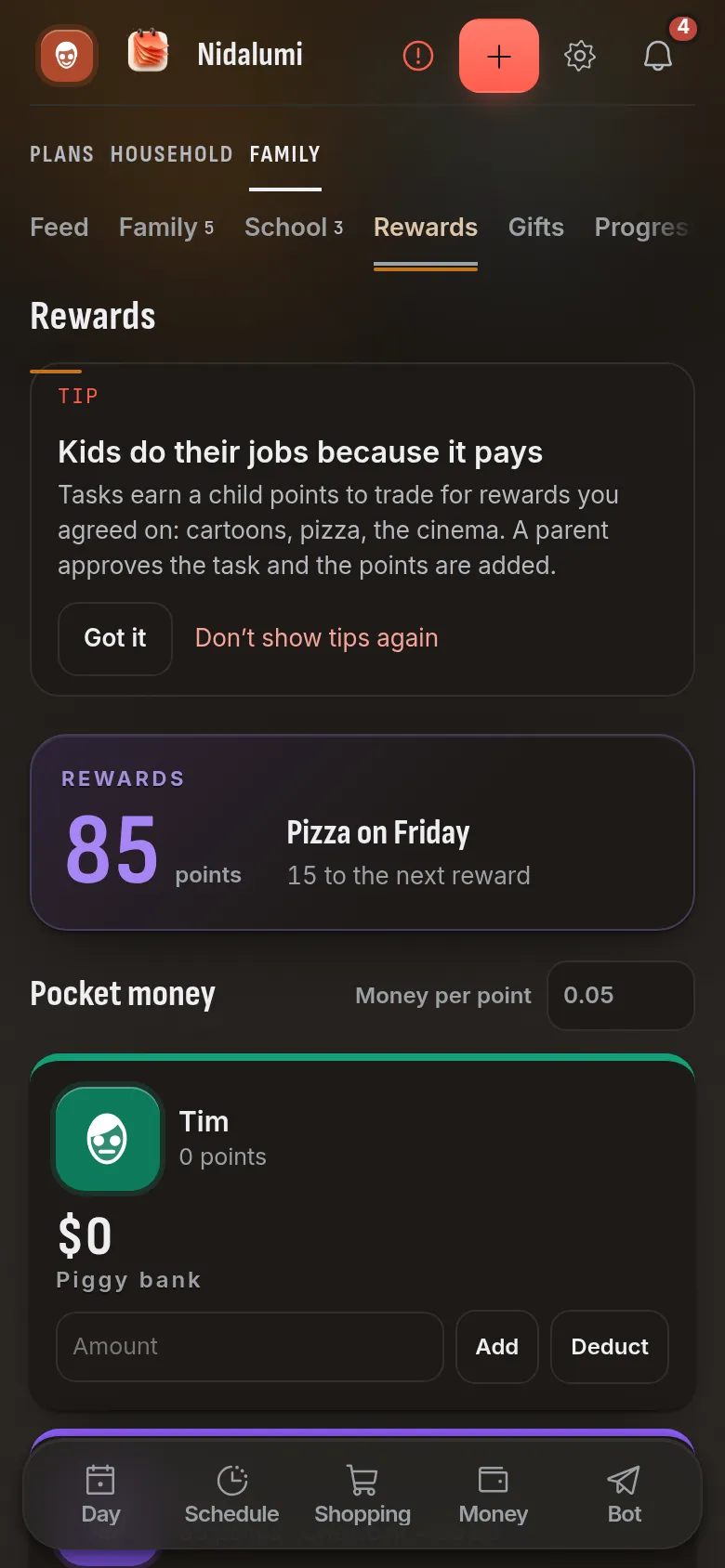
For the mixed approach this is handy: the fixed part is paid as agreed, and the extra adds itself up from the checked-off tasks, with no notebook and no arguing about what happened last week. How points and rewards work is on a separate page.
Questions and answers
So how much should I actually give?
Whatever the calculation comes to: the expenses that move over to your kid, plus a small free part. There's no ready-made amount by age. It depends on what exactly they pay for and on your family's budget.
Should I pay for chores?
That's the family's call. If you do, it helps to split chores into their own, shared, and extra, and pay only for the extra ones. Then ordinary help around the house doesn't turn into haggling.
My kid spent it all on day one. Do I give more?
If you agreed there are no top-ups, don't. But don't leave them without the essentials either: food can be packed from home. One or two weeks like that explain planning better than any talk.
Do I need to check what it was spent on?
A short list of no-gos, named in advance, is enough. A report on every purchase turns their money into yours, handed out under supervision.
Cash or a transfer to a card?
Whatever is easier for your family. For younger kids cash is clearer: they can see it, and see it running out. The rules stay the same either way.
Sources
How this guide was made: written by Christopher Clark, who builds Nidalumi. Figures and health or money facts are checked against the sources listed in the guide. We update it when the advice changes.