 Nidalumi
Chores by age: what a child can own
A chart from age 3 to 16 — not "ways to help Mom," but chores a child can carry start to finish. And how to hand them over so you don't have to keep reminding.
It's easier to do it myself than to explain. By the time I've explained where everything goes, I could have done it three times. And it's like that every time — which is why nothing changes.
Doing it for your child really is faster. Today. And a few years later there's a teenager in the house who doesn't know the trash doesn't take itself out. Below is a chart you can start with tonight.
The chart: ages and chores
| Age | What they can own | What they do with an adult |
|---|---|---|
| 3–4 | Put toys back in the bin. Put clothes in the laundry basket. Carry their own plate to the sink | Water the plants, set out spoons, wipe up a spill |
| 5–6 | Make the bed — however it turns out. Set the table. Feed the pet. Match up socks | Put away groceries, wash vegetables, dust |
| 7–9 | Pack the backpack the night before. Keep their desk tidy. Take out the trash. Wash their own dishes. Vacuum their room | A simple breakfast, hanging up laundry |
| 10–12 | Make their own breakfast. Start a load of laundry and hang it up. Go to the store with a list. Mop the floor. Pet care, all of it | Dinner for everyone, ironing |
| 13–14 | One whole area of the home: the bathroom, or the kitchen after dinner. Their own clothes from hamper to closet. A simple dinner for the family | The weekly grocery list, watching a younger sibling |
| 15–16 | Dinner for the family on their day. Shopping from a list within a set amount. Making their own appointments: a sports club, a haircut. Their own school deadlines and paperwork | Shared chores on equal terms with the adults, in rotation |
This is a guide, not a standard. Kids of the same age are very different: one washes a cup carefully at six, another still doesn't at nine. Anything involving the stove, a knife, cleaning chemicals or leaving the house without an adult is your call — based on your child and your home.
What "owning it" means
Not "did it when asked." Every chore has three parts: noticing it's time, deciding when, and doing it. If your child only does it while you notice and remind, the chore is still yours — just done with someone else's hands.
That's why the left column is short. One chore a child carries completely is worth more than five you have to ask for.
How to introduce a new chore
- One at a time. Not "starting Monday you clean your room, do the dishes and walk the dog." One chore — and add nothing for two weeks.
- Four steps. First you do it and your child watches. Then you do it together. Then they do it with you nearby. Then they do it alone. Skip a step and you get "I didn't know how."
- Agree on what "done" means. "Clean your room" means nothing to a child. "Toys in the bin, clothes in the closet, nothing on the floor" does. The younger the child, the shorter and more visual.
- Tie it to a time or an event. "After dinner," "before cartoons," "Saturday morning." A chore with no place in the day becomes "later."
- The reminder isn't your voice. A note on the door, a picture over the bed, an alarm, a notification on the phone. When Mom reminds, the child argues with Mom. When a list reminds, there's nobody to argue with.
- A mark they can see. A check mark, a magnet, a "Done" button. Kids need to see what they've done — and you don't have to ask.
What not to do
Redo it after them
The bed is made crooked, the floor still has crumbs after their vacuuming. If you quietly redo it, the lesson is simple: "someone will do it for me anyway, and better." If something needs fixing, show one trick next time, before the chore, not after. A crookedly made bed is still a made bed.
Pay for everything
When money or rewards follow every move, a child soon starts asking "what do I get for it?" about their own plate. It helps to split chores into two lists:
- Looking after yourself — backpack, bed, your own dishes, your own room. That's just part of living in a home, and nobody gets paid for it.
- For the family and beyond the usual — washing windows, clearing out the garage, making dinner for everyone. Here points, rewards or an allowance make sense.
Where the line goes is up to you. What matters is that there's one line and your child knows it.
Use chores as punishment
"You got a bad grade — you're mopping the floors." After that, mopping is a punishment, and nobody will pick it up willingly.
Call it "helping Mom"
The word "help" says whose job it really is. "This one's yours" sounds tougher but it's more honest: a child isn't a helper, they're one of the people who live here.
Hand out chores by mood
Today it's "take out the trash," tomorrow nobody remembers, the day after there's a blowup. A chore has to be written down and have its own place in the week, or it's not a responsibility, it's a lottery.
If your child is older and has never had chores
It's not too late, but read the chart from the top, not by age: first one "looking after yourself" chore, a second one two weeks later. With a teenager it's a different conversation — you don't hand things out, you negotiate; that has its own page: teens and chores.
How to keep it going without reminding out loud
In Nidalumi a child has their own tasks: the reminder goes to them, not to you to pass along. They tap "Done," and the task lands with the parent under "Waiting for your check" — to look and approve. For a small child without a phone, a parent marks it.
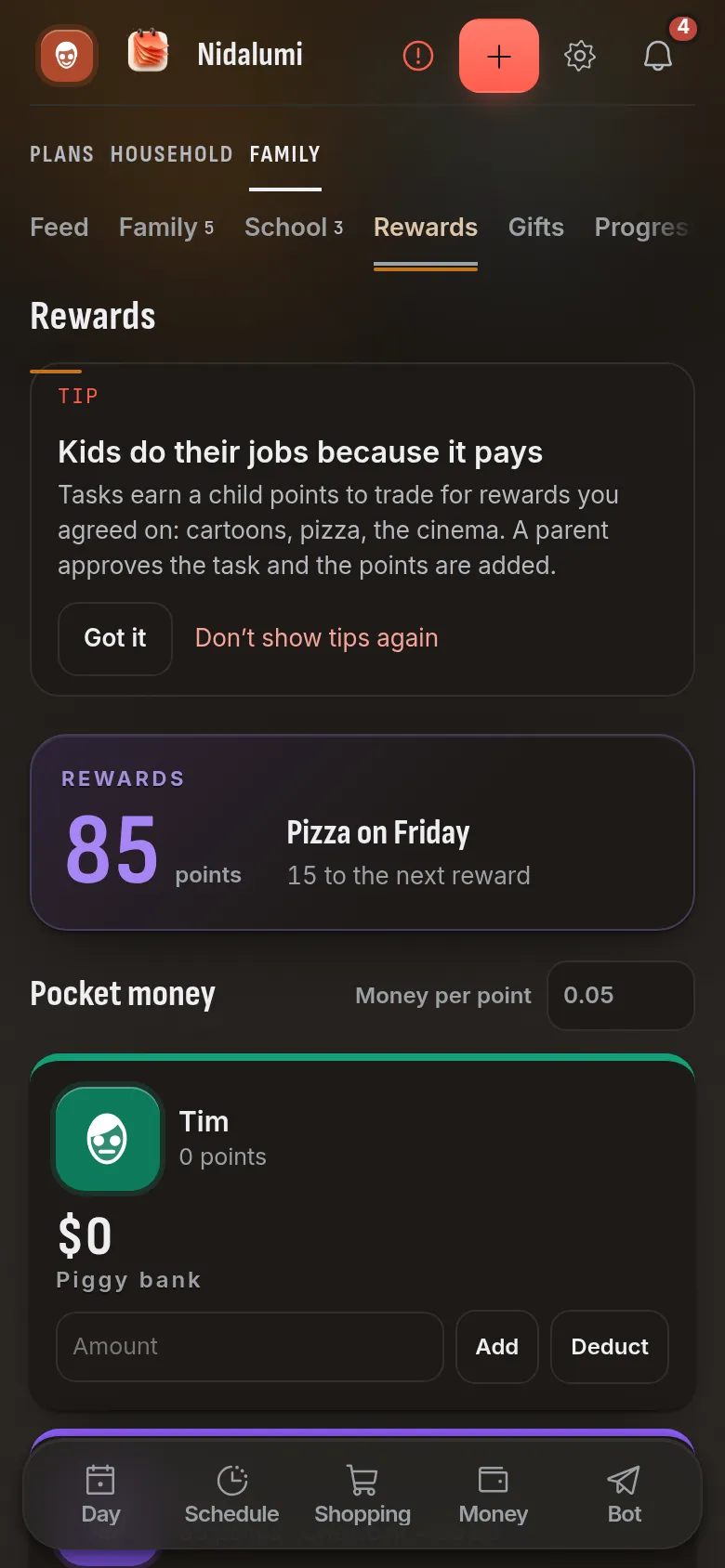
Tasks can earn points, and points can be traded for rewards or allowance — the parent sets the rate. There's a piggy bank for saving toward a goal. How it works is on the points and rewards page. In the evening a summary of the day arrives: what got done and what didn't.
Questions and answers
At what age should kids start doing chores?
Simple "looking after yourself" chores — putting toys away, carrying a plate — work as early as three or four. It's not about the amount; it's that the chore is theirs and repeats every day.
What if my child refuses?
Check three things: do they understand what "done" means, does the chore have its own time in the day, and who does the reminding. Often the refusal is an argument with your voice, not with the chore. Offer a choice of two chores and take yourself out of the reminder role.
Should kids get paid for chores?
For "looking after yourself" chores, usually not — otherwise every cup becomes a negotiation. For chores for the whole family and beyond the usual, you can, if that suits you. One rule: the line is clear to the child in advance.
The older one does more than the younger one — is that fair?
Yes, if rights grow along with chores: a later bedtime, more decisions of their own. Say that out loud. And the younger one needs a chore too, even a small one — otherwise you'll hear "why is it always me?" every day.
My child does it badly. Should I correct it?
Not right away and not silently. If the chore meets what you agreed "done" means, it counts. If not, show what's missing and let them finish it. Don't redo it for them.
How this guide was made: written by Christopher Clark, who builds Nidalumi. We update it when the advice changes.