 Nidalumi
How to start a family budget when the money "just goes somewhere"
Not with a twenty-category spreadsheet, and not with cutting back. With one month of notes and three piles. Below: the steps in order, ready-made tables and lines for the conversation with your partner.
The money goes somewhere and I don't know where. Asking feels awkward, like I'm checking up on him. And at the end of the month I can't work out why we're at zero again.
The short answer: don't start with a budget. A budget is a plan, and there's nothing to plan until you can see how the money actually moves. Start by watching. The whole thing is four steps:
- Write down every purchase for a month — no judging and no cutting back.
- At the end of the month, sort what you wrote into three piles.
- List everything that gets charged on a regular basis.
- Sit down and look at it together, calmly, once.
Step 1. A month of just writing it down
The goal of the month is to see, not to fix. So the rules are simple:
- One purchase, one line: how much, on what, who. "$42, groceries, Kate." Nothing else.
- Write it down right away, while you're still at the register. By evening the small stuff is gone from memory, and the small stuff is usually where "somewhere" is.
- Every adult writes down their own. If one person keeps the notes for two, they turn into the accountant and the other into the one being audited.
- Round it. $42 instead of $41.63 is fine. Tracking to the cent kills the habit within a week.
- Don't change your habits. Don't give up coffee this month: you'd be looking at a show version of your life, not the real one.
- Missed a day? Don't reconstruct it. Pick up from today. Incomplete notes still beat abandoned ones.
Where you write it doesn't matter. What matters is that it's one place for both of you and always within reach.
The US Consumer Financial Protection Bureau offers a free spending tracker built on the same idea: write down everything you spend first, then see where the money goes.
Step 2. Sort it into three piles
A month later you have a long list. Don't split it into twenty categories — split it into three.
| Pile | What goes in | The question it answers |
|---|---|---|
| Must-pay | housing, utilities, phone and internet, getting around, daycare and school, medicine — anything you can't skip | How much it takes for the month to simply happen |
| Living | groceries, clothes, eating out, gifts, fun, household odds and ends, subscriptions | How much goes to the way we live |
| Goals | a vacation, home repairs, a big purchase, a cushion for the unexpected | What we want to save up for |
There will be lines you disagree on: are groceries must-pay or living? Don't argue about the right answer, there isn't one. Agree once and keep putting it in the same pile.
You'll end up with three numbers. How much "should" be in each pile is yours alone to decide: there's no standard, and this page won't name one. But three numbers are something you can talk about — "it goes somewhere" turns into "it goes here."
Step 3. Bills and subscriptions in one list
The least visible money is the money that gets charged on its own. Open your transaction history for the last few months and write down everything that repeats. Separately, think of what comes once a year: insurance, taxes, membership fees.
| What | When | How it's paid | Who watches it |
|---|---|---|---|
| Rent and utilities | by the 10th | by hand | Kate |
| Internet | the 15th | charged automatically | Dan |
| Cell phones, three lines | the 1st | charged automatically | Dan |
| Art class | by the 5th | by hand | Kate |
| Streaming service | the 3rd | charged automatically | Dan |
| Car insurance | once a year, in March | by hand | Dan |
The "who watches it" column is the one that matters. A bill with no owner is a bill you remember when the late notice arrives.
Three questions for every subscription: who uses it, when it was last used, and whether you'd still pay if you had to do it by hand every month. What you do with the answers is up to you.
How to talk about money without it turning into an interrogation
A money conversation falls apart when it sounds like an audit. Nobody needs auditing — you both just need to see the picture.
| Sounds like an audit | Sounds like a shared project |
|---|---|
| "Where did the money on the card go?" | "I can't tell where it goes either. Let's both write things down for a month" |
| "Why did you buy that?" | "That's our 'living' pile. Is it enough for us, or do we want to shift something?" |
| "You spend too much" | "Look, here's how the three piles came out. Does anything surprise you?" |
What helps:
- A set time. Twenty minutes once a month, not after a fight and not at the register.
- Look at the list, not at each other. You're discussing lines, not a person.
- Free money for each of you. Agree on an amount nobody has to account for. It takes away the feeling of being watched.
- One decision at a time. Not "starting Monday we live differently," but "let's try this one thing this month."
If you have older kids, they can join in too — with their own money. How to set that up is covered on the allowance page.
Common mistakes
- Starting with bans. A budget that begins by taking something away gets dropped by everyone.
- Twenty categories right away. The more detailed the sheet, the sooner people stop filling it in. Three piles can be refined later.
- Doing it alone. Then it's not a family budget, it's one more job in your head — and one more reason for resentment.
- Forgetting the yearly bills. The month they hit, it feels like everything broke. It didn't — they just weren't on the list.
- Judging by the first month. One month is a snapshot, not a verdict. Don't draw conclusions about a person from it.
- Quitting after a missed week. A gap isn't a failure. Pick up from today.
Where to keep it
A notebook or a spreadsheet will do, but they share one flaw: they sit with one person and never remind anyone of anything. In Nidalumi each person logs spending from their own phone — in the app, on the site or in the bot — and it adds up into one shared picture. Recurring bills and subscriptions are set up once, and a reminder comes for each. Goals live right there next to the spending. Any currency works.
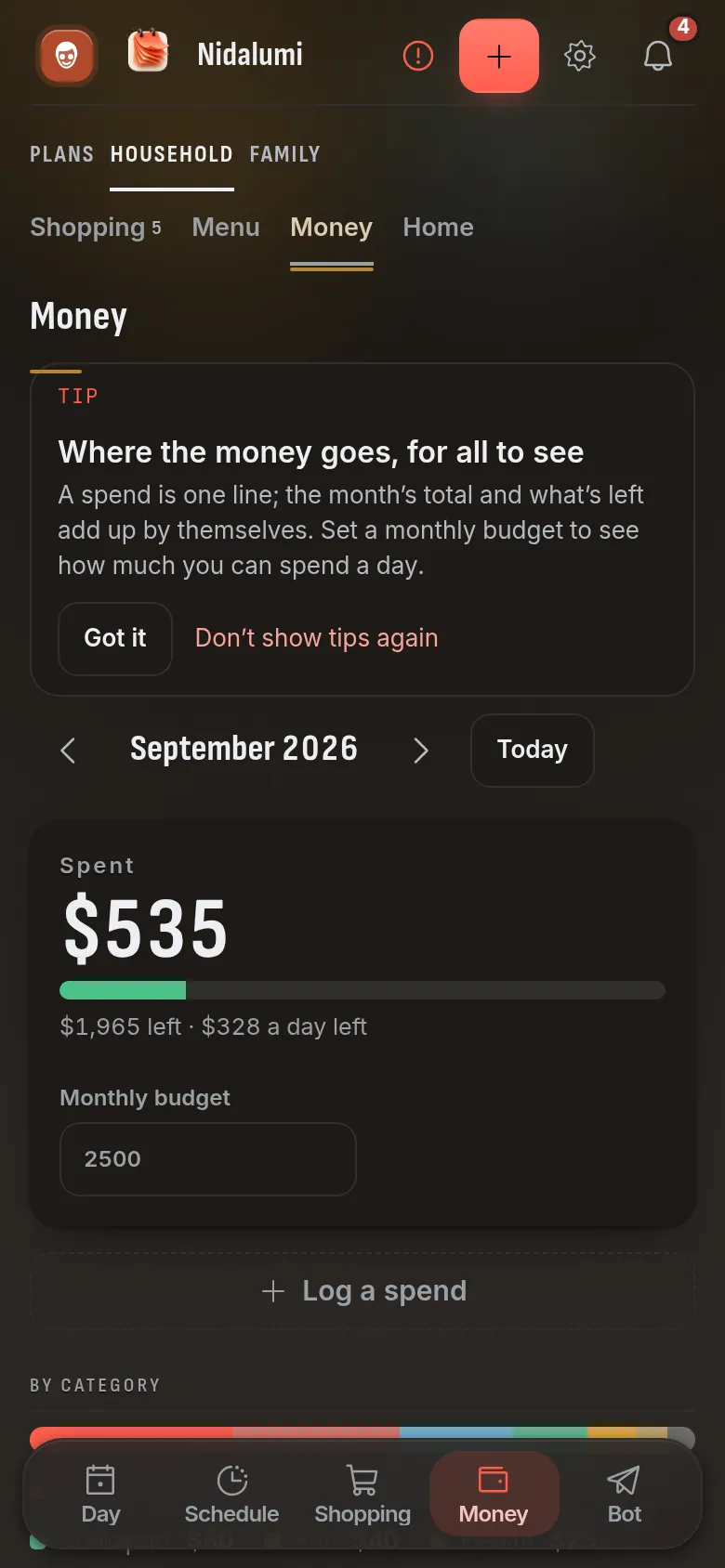
More on how it works is on the family budget and bills page.
Questions and answers
How long do we need to track spending before it tells us anything?
One month: it covers the paychecks and nearly all the regular bills. Yearly bills won't show up in it — list those separately, from memory and from your transaction history.
What if my partner doesn't want to track anything?
Don't push. Start with your own spending and the shared list of bills — that's useful on its own. Once the three piles appear, show them as a discovery, not a complaint: a list is easier to look at than questions are to answer.
Do we need to write down small things like coffee and bus fare?
For the first month, yes, rounded. The small stuff usually turns out to be that "somewhere." After that you can log it as a single line per day.
How many categories should we use?
Three piles are enough to start: must-pay, living, goals. If a couple of months in you want more detail, split one pile — the murkiest one — not all of them at once.
Sources
How this guide was made: written by Christopher Clark, who builds Nidalumi. Figures and health or money facts are checked against the sources listed in the guide. We update it when the advice changes.