 Nidalumi
A weekly grocery list: how to make one and stop going to the store every day
Three steps (the meal plan, what's at home, a list by aisle) and a ready-made basic list you can use today. Plus how not to forget the small stuff and not do all the shopping alone.
Every evening it's the same: "what's for dinner?" and off I go to the store for three things. I walk out with a full bag and I still forgot the sour cream.
People don't go to the store every day because they bought too little. They go because they bought without a plan: nobody knows what's being cooked, nobody knows what's already at home, and the list is in one person's head. The routine below takes about half an hour once a week.
The routine: three steps
1. The meal plan: dinners and packed food only
There's no need to map out breakfast, lunch and dinner for seven days. Plans like that get dropped in week two. This is enough:
- five or six dinners (leave one evening for leftovers or for eating out);
- breakfasts in one line: usually there are two or three kinds on rotation;
- what gets packed for school and work.
It's easy to build the plan from templates: one dish that covers two days, one quick one for the busiest evening, one "from what's always around" (pasta, eggs, something from the freezer). Glance at the week's schedule: on the day everyone gets home late, a complicated dinner isn't needed.
2. What's at home
With the meal plan in hand, check three places: the fridge, the freezer, the pantry shelf. It takes five minutes, and it gets rid of both extra purchases and "we thought we had some, and we didn't."
- Whatever will go bad soon goes into the first days' dinners.
- Whatever you already have gets crossed off the future list.
- Whatever is down to the last bit gets added.
3. A list by store aisle
Write it out not by dish but by aisle, in the order you walk through the store. A list by dish sends you back to the dairy case three times; a list by aisle is one pass.
Put the quantity next to each item: "milk, 3," "chicken, for two dinners." A line that just says "cheese" ends in a call from the store.
A ready-made basic list by aisle
This is a foundation: what nearly everyone needs in most weeks. Cross out what doesn't apply, and add your own for the meal plan.
| Aisle | What's usually on the list |
|---|---|
| Produce | potatoes, onions, carrots, lettuce, cucumbers, tomatoes, garlic, fresh herbs, apples, bananas, lemons |
| Dairy and eggs | milk, yogurt, cottage cheese, sour cream, butter, cheese, eggs |
| Meat, poultry, fish | chicken, ground beef, a cut for soup or stew, fish |
| Bread | sandwich bread, rolls or tortillas |
| Pantry staples | rice, pasta, oatmeal, dried beans, flour, sugar, salt, cooking oil |
| Canned goods and sauces | canned tomatoes, peas or corn, canned tuna, whatever you dress salads with |
| Frozen | mixed vegetables, berries, frozen pizza or dumplings for a backup dinner |
| Tea, coffee, snacks | tea, coffee, cookies, whatever the kids take for a snack |
| Drinks | water, juice |
| Household | dish soap, sponges, trash bags, laundry detergent, toilet paper, paper towels |
| Personal care | toothpaste, soap, shampoo |
| For the pet | food, litter |
How not to forget the small stuff
Nobody forgets the meat or the milk. They forget salt, foil, batteries, sponges: things that run out rarely and quietly. Three tricks:
Ran out, wrote it down. Not "I should remember that," but a line on the list the minute you shake out the last of it. For that, the list has to be within everyone's reach, not on one phone.
The last-package rule. Opened the last one, wrote it down. Not when it's gone, but when it's opened: the backup on the shelf buys you time until the next big shop.
An "always at home" list. Ten to fifteen items your house should never run out of: salt, oil, tea, toilet paper, pet food. Before the big shop you run your eyes down it, which is faster than trying to remember.
One big shop and one small one
Buying everything for seven days in one go doesn't work: bread, herbs and milk don't last that long. The honest setup is two trips:
| The big shop | The top-up | |
|---|---|---|
| When | once a week, on the same day | once, midweek |
| What | meat, pantry staples, frozen food, produce that keeps, household items | bread, dairy, herbs, fruit |
| How long | one calm pass with the list | ten minutes on the way home |
A top-up with a short list isn't "the store again." It's ten planned minutes in place of five random trips.
How to split the shopping between adults
He says: "Just write it down and I'll buy it." So remembering, checking and making the list is me. And he "went to the store."
Going to the store is a third of the work. The other two thirds are noticing what's running out and making the list. It's worth splitting the whole thing, not just the bags. Options:
- By trip. One adult does the big shop, the other does the midweek top-up. Each one checks the shelves for their own trip.
- By area. One takes food; the other takes household items, personal care and pet food. Each person runs their area completely: watches what's running out and buys it.
- By week. Your week, my week, meal plan included.
Whichever option you pick, there's one condition: the list is shared, and anyone adds to it. Whoever finishes the milk writes it down. Otherwise one person stays the "warehouse in their head" and the other is the delivery driver. More on this in the guide on how to split household chores.
When the list is shared, not yours
Everything above can be done on paper, right up until a second person needs the list in the store. In Nidalumi, there's one shopping list per family: anyone adds to it, one line is one item, and the "bought" mark is visible to everyone right away. An item can be assigned by naming who buys it. Supplies holds your "always at home" list: when something runs out, it lands on the shopping list automatically. The weekly menu and the schedule live there too, next to the list.
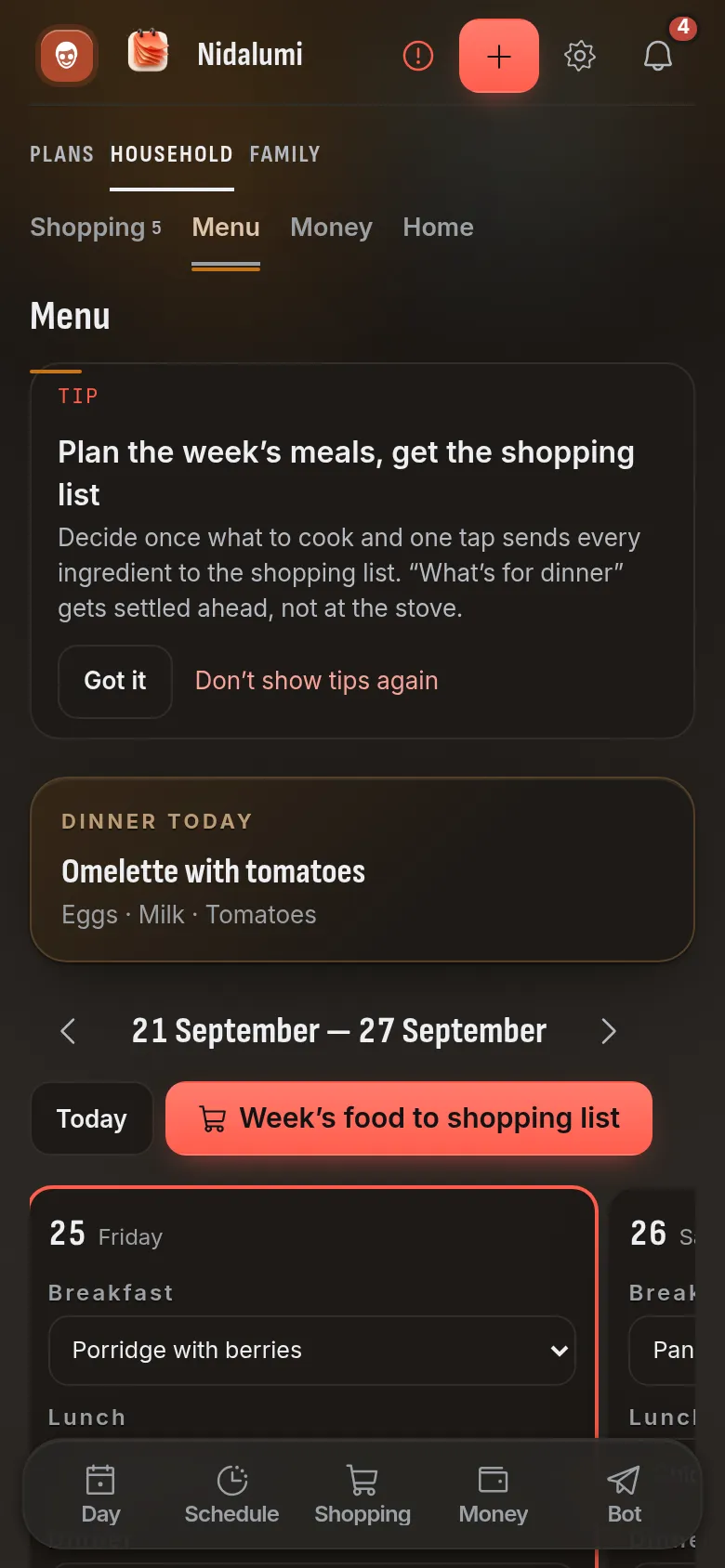
How the shared shopping list works is on a separate page.
Questions and answers
How long does a weekly list take?
The first time, about half an hour: meal plan, shelf check, list. Once you have your own basic list and a couple of familiar meal plans, ten to fifteen minutes is enough.
Do I have to make a meal plan?
A full one, no. It's enough to know the dinners: they're the most common reason for an evening store run. Breakfasts and snacks usually repeat and end up on the basic list.
What if plans change during the week?
Leave one free evening in the plan and keep a backup dinner from the freezer or the pantry. Dishes can swap days, since the ingredients are already at home.
How do I avoid buying extra?
Follow the list and the aisles, skipping the ones that aren't on it. And check the shelves before the store: most of the extra is stuff that was already at home.
How do I get everyone else to add to the list?
Make it take seconds, with the list on everyone's phone. And agree on a rule: opened the last package, wrote it down. If it isn't on the list, it doesn't get bought.
How this guide was made: written by Christopher Clark, who builds Nidalumi. We update it when the advice changes.