 Nidalumi
How to split household chores in a family: fairly and without a fight
One evening, one list and five steps. Below is a ready-made list of household jobs by area, rules for dividing them, and lines to open the conversation with.
He says he helps. Helps who? So it's all mine, and he's doing me a favor?
In most families chores were never divided. They just settled on whoever noticed first. Nobody decided it would be this way. So the way to change it isn't blame, it's an ordinary procedure: a list, a split, a check-in after two weeks.
The method in brief
- Write down every job in the house, by area, not from memory.
- Hand out whole areas: each one gets a single owner.
- Agree on what "done" means.
- Deal separately with the contested stuff, the jobs nobody wants.
- Sit down in two weeks and adjust.
Step 1. The full list of jobs by area
Use the table as a starting point: cross out what doesn't apply, add your own. The point is to have the entire volume on the table, not just the three jobs you usually argue about.
| Area | What it includes |
|---|---|
| Food | Meal plan, grocery shopping, cooking, breakfasts, packed lunches |
| Kitchen | Dishes, stove and counters, fridge, trash |
| Laundry and clothes | Washing, drying, folding and putting away, ironing, swapping seasonal clothes, shoes |
| Cleaning | Floors, dusting, bathrooms, bed linens, windows |
| School | Getting ready, homework, the class group chat, parent-teacher meetings, lunch money |
| Activities and sports | Drop-off, pick-up, gear, payments, schedule |
| Health | Doctor's appointments, forms, medication, the first-aid kit |
| Money and bills | Utilities, phone and internet, subscriptions, loans, insurance |
| Car | Gas, car wash, maintenance deadlines, tires, paperwork |
| Pet | Food, walks, litter box, vet |
| Aging parents | Calls, medication, rides to the doctor, help around their house |
| Holidays and gifts | Birthdays, gifts, guests, trips |
| Paperwork and odds and ends | Document deadlines, meter readings, repairs, "call the repair guy" |
Go down the rows and next to each one write who handles it now. Don't judge and don't comment. Just names. That column usually speaks louder than any conversation.
Step 2. Hand out areas, not errands
An errand is "take out the trash." An area is "trash is yours": the person sees the bin is full, knows when to take it out, and takes it out. Why that's the only way the load truly leaves is covered in the guide to the mental load. Here's how to do the dividing.
One owner per area. "We're both in charge of dinner" in practice means the one in charge is whoever cracks first.
Divide by time, not by number of rows. "Food" takes hours every day; "car" takes a few times a year. Five areas against five isn't necessarily fair. Look at how much an area takes per week and whether it can be put off.
Daily jobs get split evenly. The ones that can't be postponed (food, kids, dishes) are the heaviest. If one person has all of them and the other has only "weekend stuff," it won't be equal however you count.
Start with who wants what. Some people find cooking easier than cleaning; some are better with bills. Hand out the wanted ones first, then the rest.
On the way and on the schedule. A practice near someone's office, a pharmacy by someone's train stop: that's a solid argument.
Kids get their share. Small, age-appropriate, but their own. For ideas, see the list of chores by age.
Step 3. What "done" means
Most fights after the split aren't about whether something got done, but how. So each area needs an agreed minimum. Anything above the minimum is up to the owner.
| Area | The minimum you agreed on |
|---|---|
| Dishes | The sink is empty by morning |
| Laundry | Clean clothes are in the closet, not on the drying rack; gym clothes are ready for gym class |
| Dinner | On weeknights there's a hot meal by 7:30 p.m.; what exactly is up to the cook |
| Trash | The bin doesn't sit full overnight |
| School prep | The backpack is packed the night before |
The rule is simple: whoever owns the area decides how to run it. If the minimum is met, the method isn't up for discussion. Dishes washed in the wrong order are still washed dishes.
Step 4. Contested jobs
Nobody wants it (the toilet, trash, ironing). Don't pin it on one person forever; put it on a rotation: one week one person, the next week the other. A rotation takes away the "why me again" question.
Both want it, but done differently. Give it to the one who cares more about the result, along with the right to do it their way. The other one doesn't comment.
Rare, and therefore nobody's (meter readings, insurance, tires). Assign an owner and a date right away. A job without a date stays in the head of whoever remembers it.
Unequal in weight. Trade: "I'll take the bathroom, you take the ironing." A trade is fairer than a tally.
"I'm no good at it." Then the area is handed over with a short briefing: where things are, what time, what counts as finished. Once, not every time.
Not enough hands for everything. Decide honestly what gets done less often or more simply. Windows once a season is an agreement too.
Step 5. A review after two weeks
The first split is never accurate. Put a fifteen-minute meeting on the calendar and go through three questions:
- What never once got done without a reminder?
- What turned out heavier than it looked?
- What would you like to trade?
After that, once a month and every time life changes: a new school year, a different job, a move, an illness. A family meeting is a good place for it.
Where to keep what you agreed on
An agreement that isn't written down anywhere lasts a week. Then comes "but we agreed," and the argument starts over. Anything works as long as both of you can see it and it reminds people by itself: a sheet on the fridge can't remind anyone, so it's usually the first to give up.
In Nidalumi, every task has a person, and the reminder goes to them, in Telegram or as a notification on their phone. Take-turns jobs run as a rotation: it passes the job to the next person automatically, and you can swap. In the evening there's a daily summary: what got done and what didn't. At the review you look at that, instead of trying to recall who promised what.
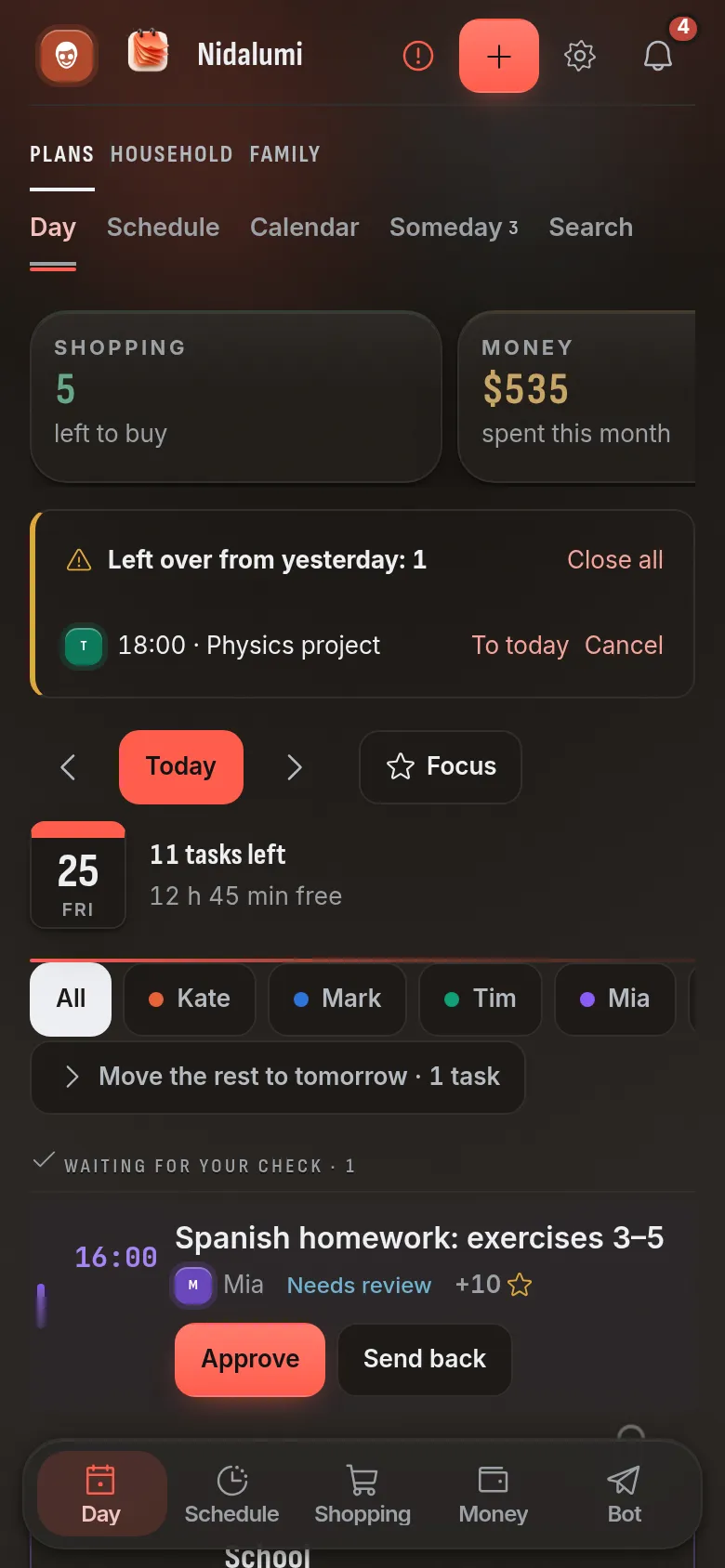
How it works in Nidalumi: Family Chore Rotation.
Questions and answers
How do we split things if one of us works more than the other?
Count time, not rows. Add up each person's work hours and hours on the house, and see how much free time each has left. A fair split is when rest is roughly equal, not when the chores are fifty-fifty.
What if the answer I get is "just tell me what to do"?
Show the list and offer a choice of areas. The "telling" is work too: remembering and saying it on time. A whole area takes it off both of you: one doesn't have to tell, the other doesn't have to wait for instructions.
My partner does it, but not the way it should be done. Do I redo it?
No, if the agreed minimum is met. If the result truly doesn't work, clarify the minimum at the review. Redoing things and commenting along the way sends the job back to you faster than anything.
Should the kids be included?
Yes, with small age-appropriate jobs the kid runs from start to finish. One job of their own beats five rounds of "help Mom."
How often should we review?
The first time after two weeks, then once a month and whenever something changes: school, work, a move.
How this guide was made: written by Christopher Clark, who builds Nidalumi. We update it when the advice changes.