 Nidalumi
Medication for elderly parents: keeping track from a distance without hovering
Call, and they feel checked on. Don't call, and you think about it all day. There's a way out: make sure the reminder isn't you and isn't a phone call. Here's how to set it up in a single visit.
Mom's pills are on a strict schedule. I'm a hundred miles away and I still wonder: did she take them or not? If I call, she'll feel like I'm checking up on her. If I don't, I think about it all day.
The short answer is four things:
- One list of medications and times, in the doctor's words, on paper.
- One spot and one pill organizer, filled for the week.
- A reminder for the person themselves, on their phone, instead of your call.
- A "taken" check mark you can see without asking.
1. One list, in the doctor's words
Prescriptions usually live in three places: the visit summary, the boxes and someone's memory. Pull them into one table and ask the doctor to check it at the next appointment.
| Medication | When | How to take it | Prescribed by | When it runs out |
|---|---|---|---|---|
| name from the package | morning, 8:00 a.m. | as the doctor said: before food, after, with water | primary care doctor | October 20 |
| name from the package | morning and evening, 8:00 a.m. and 8:00 p.m. | as the doctor said | cardiologist | November 5 |
| name from the package | at bedtime, 10:00 p.m. | as the doctor said | primary care doctor | time to refill |
Questions worth asking the doctor, with the answers written right into the list:
- What should we do if a dose is missed?
- Until what date should each medication be taken?
- Is it okay to sort these pills into an organizer ahead of time?
- If different doctors prescribed different things, do they all work together?
One copy stays with your parent somewhere visible, and a photo stays with you. After every doctor's visit the list gets rewritten and the old one thrown away. Two lists are worse than none.
2. One spot and one pill organizer
The confusion starts when boxes sit in the kitchen, and in the bedroom, and "there was another pack somewhere."
- A weekly pill organizer with compartments for times of day. It gets filled once a week, on the same day. Before you start, check with the doctor or pharmacist whether these medications can be taken out of their packaging ahead of time.
- Who fills it is something you decide together. Ideally your parent does. If that's hard, you do it on your visit, or a neighbor or a home care aide does.
- The spot is tied to a habit: by the kettle, on the kitchen table, by the bed. Wherever the person already is at the right time. Not in a cabinet.
- The rest of the packages go in one box. Kept apart from old "just in case" medicine: that's the easiest thing to mix them up with.
- Refills. The list has a "when it runs out" column, and it's worth buying a week before that date. Decide right away who does the buying.
3. A reminder for the person themselves
The "did you take it?" call isn't bad because you're worried. It's bad because it turns a grown adult into someone being watched. A reminder on their own phone is like an alarm clock: it's theirs, not yours.
What fits depends on the tech:
- They have a smartphone: a reminder arrives on it at the right time, with the name of the medication.
- A basic flip phone: daily alarms for each dose time.
- They don't use a phone: the organizer sits next to something that already happens every day (breakfast, the evening news), plus a weekly sheet to check off.
It's better to tie the time to events in the day than to numbers on a clock: "after breakfast" is easier to remember than "at 8:30." But only within the limits the doctor allowed.
The World Health Organization estimates that in developed countries only about half of people with long-term conditions take their medicines as prescribed.
4. How to see it was taken, without calling
You don't need a conversation about pills. You need to know everything's okay. Those are different things, and you can get the second one without a call.
- A check mark on the phone. The person taps Done in the reminder, and you see it on your end.
- A sheet with check marks, if there's no phone. Whoever stops by sees it: a neighbor, a home care aide, you on your visit.
- An "after such-and-such time" rule. Agree on it ahead: "If there's no check mark by ten in the morning, I'll call. Not to check on you, just to make sure you're all right." Then the call isn't distrust. It's your deal.
And keep regular calls for talking. When "did you take it?" disappears from the first minute, the conversation gets easier for both of you.
How to say it without hurting their feelings
An older person hears something else in concern about medication: "you can't manage anymore." So what matters isn't what you suggest, it's how.
| Sounds like control | Sounds like a request |
|---|---|
| "Did you forget your pills again?" | "I get anxious when I'm far away. Help me not pester you with calls" |
| "I'm going to check that you're taking them" | "Let's have the phone remind you, and I'll just see that everything's fine" |
| "You can't be trusted with this" | "What works best for you: what time, where to keep them, who fills the organizer?" |
What helps:
- Ask for your own sake. "It gives me peace of mind" is true, and it's hard to take offense at.
- Your parent decides. The time within what was prescribed, the spot, the kind of reminder: their choice. You suggest, you don't impose.
- Not in front of others. Don't discuss medication in front of the grandkids or guests.
- If the check mark is there, don't ask again. Otherwise it hasn't replaced anything.
- A missed dose is a reason to fix the setup, not to lecture: an awkward time, the wrong spot, an alert that's too quiet. What to do about the missed dose itself is in the list, in the doctor's words.
If there are several of you adult children, agree on whose job this is, whole: the list, the pharmacy, the reminders. When "everyone keeps an eye on it a little," no one does. For how to hand over a job rather than an errand, see the guide to the mental load.
How it works in Nidalumi
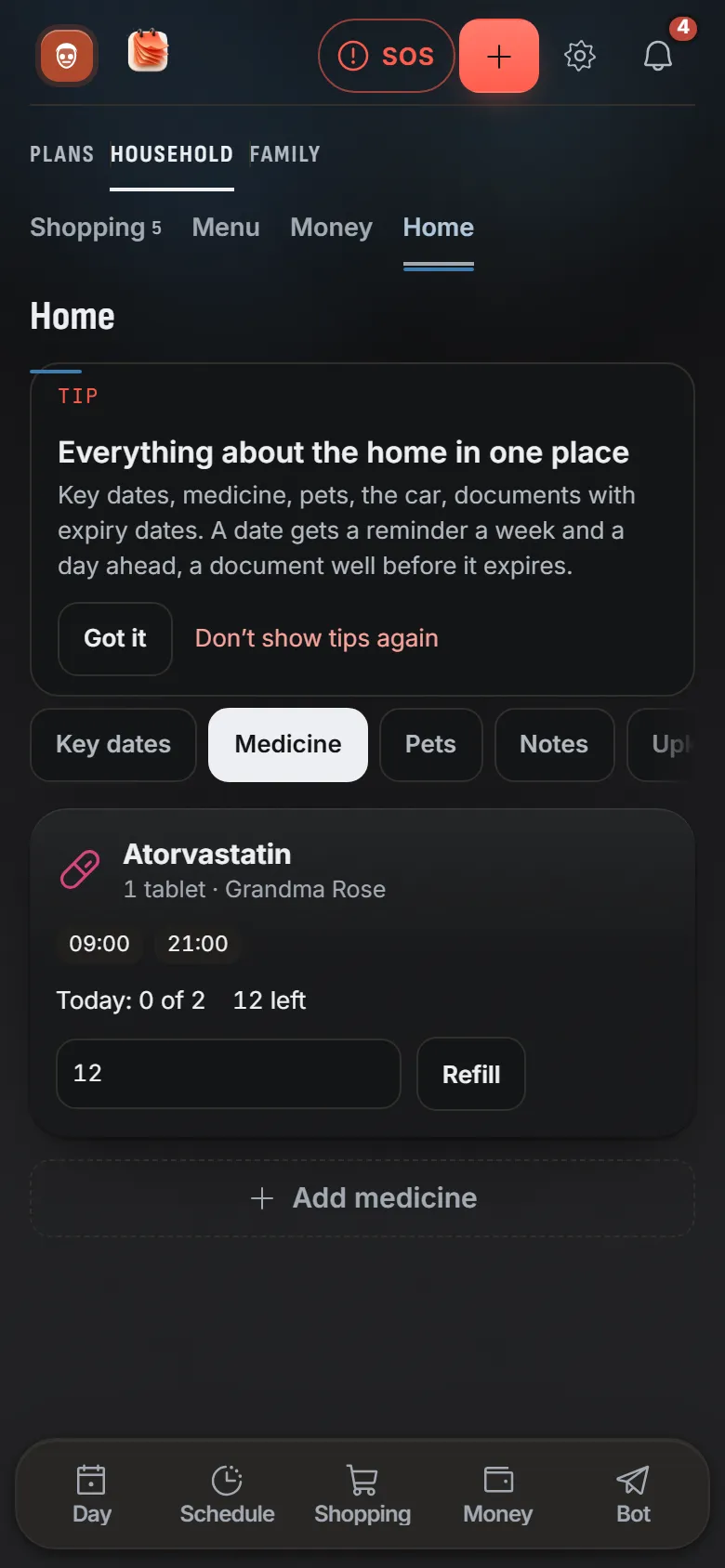
In Nidalumi, a medication is set up with its time, the one the doctor prescribed. The reminder goes to your parent directly: in Telegram or as a notification on their phone. They tap Done, and you don't have to ask: the Medicine section shows how many doses were checked off today and how many pills are left, which also tells you when it's time for the pharmacy.
More on the medication reminders page.
Questions and answers
What if my parent doesn't have a smartphone?
It works without one: a weekly pill organizer somewhere visible, daily alarms on a basic phone, and a sheet with check marks. In that case the check mark is seen by whoever stops by, so agree ahead of time on who that is.
My parent says "I remember everything myself" and refuses. What now?
Don't argue about whether they remember. Ask for your own sake: "I feel calmer when I can see the check mark. Do it for me." And leave every decision to them: time, spot, method.
A dose was missed. What do we do?
Only the doctor decides that. It's best to ask in advance, at an appointment, and write the answer right into the list next to the medication, so nobody has to guess in the moment.
Can I manage my parent's medication if they don't want to tap anything?
You can set up reminders for yourself, so you fill the organizer and buy refills on time. But then there's no "taken" check mark, and you get only half the peace of mind.
Do the reminders require Telegram?
No. A reminder can arrive as a phone notification, through the app that installs from the website.
This guide helps you organize reminders; it doesn’t replace advice from a doctor or pharmacist.
Sources
How this guide was made: written by Christopher Clark, who builds Nidalumi. Figures and health or money facts are checked against the sources listed in the guide. We update it when the advice changes.