 Nidalumi
Medication reminders for the whole family
The reminder goes to whoever takes the medication: your kid, you, your mom in another city. Below is what to write down for each one, so that doses stop depending on one person's memory.
Mom's pills are on a strict schedule. I'm a hundred miles away and I still wonder: did she take them or not? If I call, she'll feel like I'm checking up on her. If I don't, I think about it all day.
People don't forget medication because they're careless. Doses are tied to the clock, and the day isn't: a late meeting, traffic, friends dropping by. And almost always, one person carries the whole family's medicine cabinet in their head: the antibiotic for your son, your own vitamins, Mom's blood pressure pills.
What to write down for each medication
A line that says "pills in the morning" isn't enough. For a dose not to depend on your memory, each medication needs six answers, and all of them come from the prescription and the package:
| What to write down | Example |
|---|---|
| Who takes it | Mom |
| What exactly | The name on the package, as the doctor wrote it |
| What time | 8:00 a.m. and 8:00 p.m. |
| How to take it | After food, if that's what the doctor said |
| Until what date | Through October 14, or "ongoing" |
| Where it's kept and how long it will last | Top shelf; enough to last through the end of the month |
That last row saves you from the most frustrating miss of all: you remembered the pill, and the bottle is empty.
Three reasons doses get missed
- The reminder goes to the wrong person. The alarm is on your phone, but someone else has to take the pill. That adds a step: you get reminded, you call, and you hear "I know, I know."
- One alarm for everything. If the 8 o'clock alarm means three different medications for three different people, everyone stops hearing it fast.
- Nobody knows whether it was taken. An hour later, no one remembers if the pill happened. Cue "did you take it?" and the irritated answer.
The fix: every medication gets its own person, its own time, and a check mark anyone can see without asking.
The World Health Organization estimates that in developed countries only about half of people with long-term conditions take their medicines as prescribed. How and when to take each medicine is in its leaflet or on NHS Medicines A–Z.
How it works in Nidalumi
In Nidalumi, medication lives in the Home section, next to pet care, car deadlines and documents.
A medication has a time. You set it up once, and from then on the reminder shows up by itself, right on time.
The reminder goes to the person who takes it. In Telegram or as a notification on their phone. Your teenager gets theirs, you get yours. No middleman.
Aging parents get their own reminder. Your mom gets it on her phone, not a check-up call from you. It's a different conversation: the phone reminded her, not a daughter who's "hovering again." How to set this up gently and from a distance is covered in the guide to medication for elderly parents.
A parent checks off for a little one. If a child has no phone, the reminder goes to an adult, and that adult marks it done.
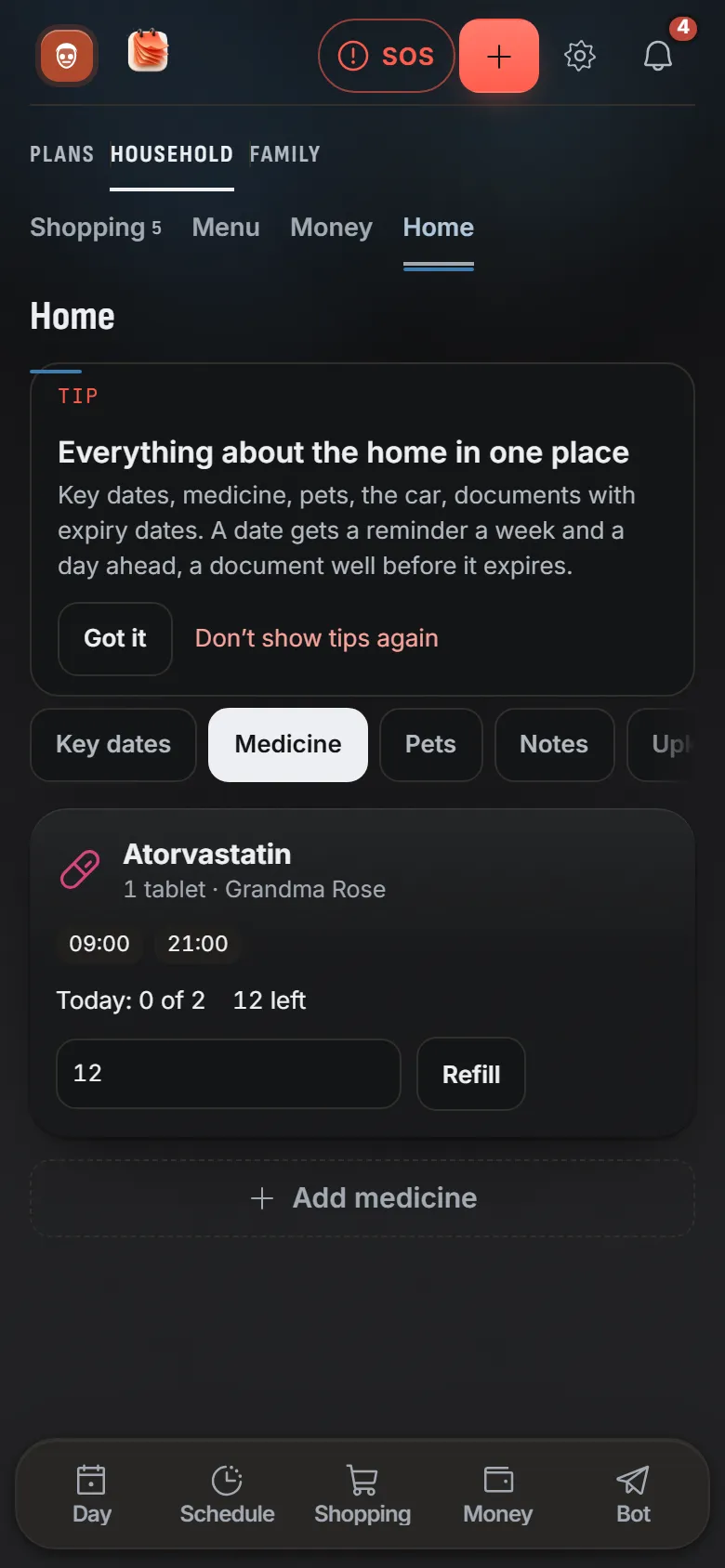
Refill on time. When a package is running low, add it to the shared shopping list and assign who buys it: they'll get a message and see it on their own phone.
Example: the whole family's medication on one page
| Who | When | Who gets the reminder |
|---|---|---|
| Son, 6, a one-week course | morning and evening | Mom or Dad, and they check it off |
| Daughter, 14 | once a day, in the morning | she does |
| You | in the evening | you do |
| Mom, lives on her own | morning and evening | Mom, on her own phone |
Fill in the names and times from the prescriptions. The point of the table is the last column: every row has its own recipient, and none of them runs through your head.
Where to start
- Gather every prescription in one place: doctor's notes, printouts, packages.
- Add the medications one at a time: who takes it and when, as the doctor wrote.
- Invite the people who take them into the family, so the reminder goes to them, not to you.
You can set up the rest of your family reminders the same way. Medication is usually where the difference shows first.
Questions and answers
Will the service tell me what to take and how?
No. Nidalumi only reminds you about what a doctor has already prescribed. The medication, dose, timing and duration are decided by the doctor.
Can I set up medication for my elderly mom who lives on her own?
Yes. You add her to the family, and the reminder goes to her, in Telegram or as a notification on her phone.
What if someone doesn't use Telegram?
It's optional. Reminders also arrive as phone notifications: the app installs from the website on Android and iPhone.
How much does it cost?
5 days free, no card needed. After that it's $3.99 a month or $35 a year for a family of up to four, and that covers the whole planner, not just medication.
This guide helps you organize reminders; it doesn’t replace advice from a doctor or pharmacist.