 Nidalumi
Mental load: why you're the one who remembers everything, and how to share it
The chores aren't what wears you out. It's remembering, deciding and reminding for everyone. Here's where that comes from, and how to hand over whole jobs instead of single tasks.
I'm not tired of doing things. I'm tired of deciding and reminding. Washing the dishes takes ten minutes. Reminding someone about the dishes twenty times takes the whole evening.
If that sounds like you, there's nothing wrong with you. You're not "too controlling" and you're not "bad at asking for help." Your head is simply running dispatch for the entire family, and dispatch never gets a day off.
What the mental load is
Every household job has three parts:
- Noticing that it exists. The gym clothes are dirty, and gym class is tomorrow.
- Deciding when and how. So the laundry has to go in before eight tonight, or it won't dry.
- Doing it. Putting it in the washer.
The third part is visible. The first two aren't. The mental load is those first two parts, all piled up in one head. The person who "just threw it in the washer when asked" honestly believes they did half. In reality they did a third, and you did two thirds, plus the reminding.
That's why "well, you never told me" stings so much. The whole arrangement is in that sentence: remembering is yours, saying it on time is yours, and doing it counts as "helping."
Sociologist Allison Daminger calls this the cognitive side of housework: anticipating needs, weighing options, deciding and keeping track of how it went — work that mostly stays invisible.
How to tell the load is on you
Check off the ones you recognize:
- People ask you "so what needs doing?" and you hand out tasks all over again.
- You know everyone's schedule: practices, doctor's appointments, birthdays, when the pet food runs out.
- If you dropped out for two days, everything would stall. Not because nobody can do it, but because nobody knows what's even supposed to happen.
- It's easier to do it yourself than to explain where things are and what time.
- You snap over socks, though it isn't about the socks. It's that this is the two hundredth thing this week.
- You're lying down, and the list keeps scrolling in your head.
Three or more, and dispatch is running at your desk.
Why asking for "more help" doesn't work
Because "helping" means carrying out someone else's list. The list stays with you. You still notice, decide, remind and check; the other person still waits for instructions. They're not lazy and they're not mean. They simply have no way of knowing what needs doing: it's all written down in your head, and nobody else has access.
The conclusion is unpleasant but freeing: as long as the list lives in one head, the load can't be shared. All you can do is hand out errands, and handing out errands is the load.
Three steps to really share it
1. Get the list out of your head and into a place everyone can see
One evening. Write down everything that repeats: school, activities, groceries, bills, medication, cleaning, the pet, the car, gifts. Not "the important stuff." Everything. It usually comes to a few dozen lines, and that's the first relief: it's no longer "I'm tired for some reason," it's a specific inventory.
The list has to live where everyone looks, and it has to do the reminding. Otherwise you'll stay on as the reminder service attached to the list.
2. Hand over the whole job, not a step
Not "take out the trash" but "trash is yours." Whole means all three parts: noticing, deciding, doing. The person keeps an eye on the bin, knows when pickup day is, and takes it out. You don't think about it anymore.
| An errand (the load stays with you) | A whole job (the load leaves) |
|---|---|
| "Pick up Emma from dance today" | "Dance on Tuesdays and Thursdays is yours: drop-off, pick-up, the outfit" |
| "Grab bread on your way home" | "Breakfast groceries are yours: you watch what's running out and you buy it" |
| "Remind Mom about her pills" | "Mom's medication is yours: the schedule, the pharmacy, the reminders" |
3. Stop being the backup reminder
The hardest one. Once a job is handed over, don't check, don't remind, don't redo it. It will get done later, differently, sometimes worse. That's the price, and it's lower than it looks: gym clothes washed at midnight are still washed gym clothes.
To keep yourself from sliding back into checking, agree on one place where it's visible whether something is done. Looking isn't the same as reminding.
What it looks like when your head isn't the one remembering
In Nidalumi, the list lives in one place for the whole family, and every task has an owner. The reminder goes to them, in Telegram or as a notification on their phone, not to you to pass along. Each task has a Done button, and in the evening there's a daily summary: what got done and what didn't. You don't have to ask. You can just see it.
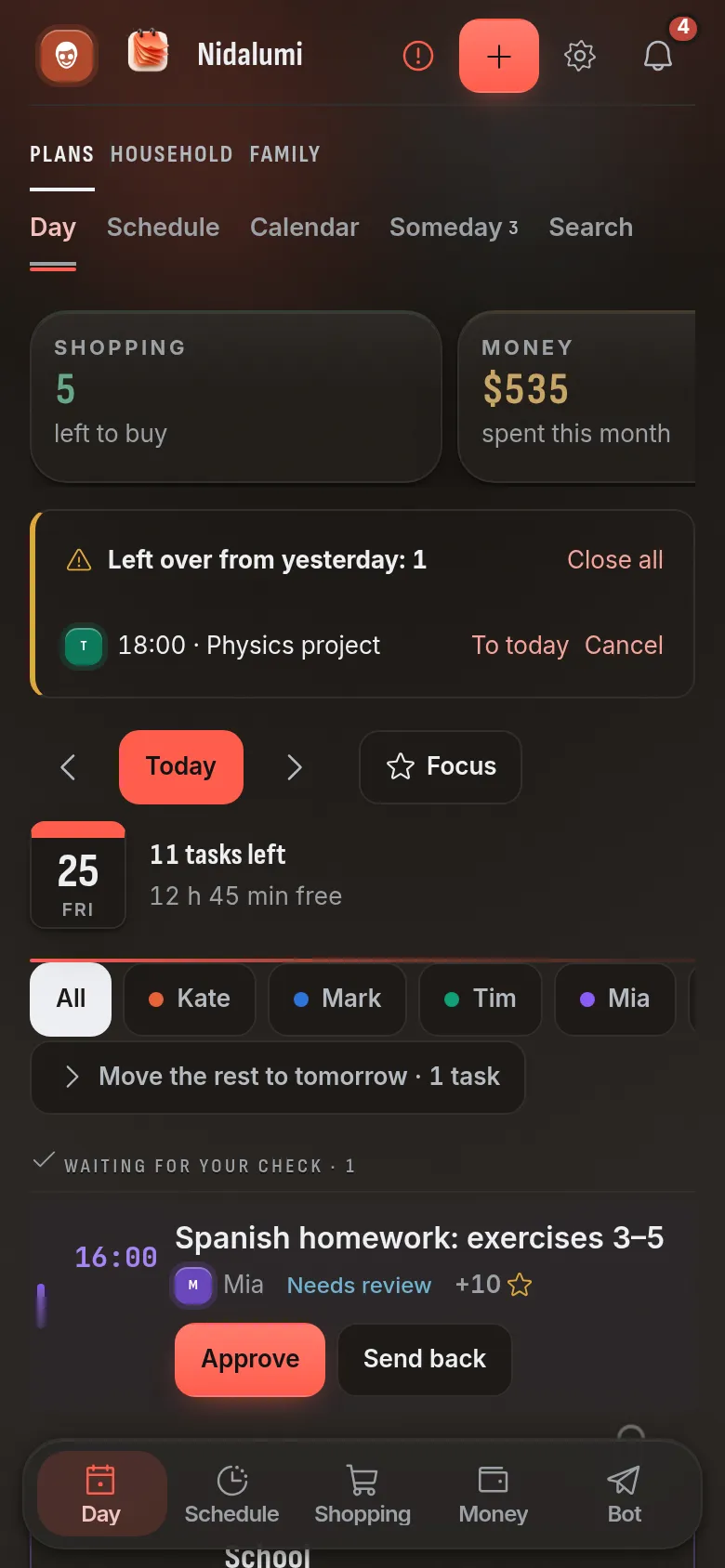
Anything that repeats (practices, chore rotations, medication, bills) gets set up once and then sends its own reminders. Shopping is a shared list anyone can add to. That's how the first two parts of a job, noticing and deciding, stop being your work.
How it works in Nidalumi: Family Reminders.
Questions and answers
Is the mental load the same thing as housework?
No. Housework is the doing. The mental load is remembering that a job exists, deciding when and how to do it, and making sure it got done. It's invisible, which is why it's so hard to split.
What do I do when my partner says "just tell me what to do"?
Explain that the telling is the work. Offer whole areas instead of errands: "breakfasts are yours," "Tuesday practices are yours," including the noticing and the deciding.
What if I hand it over and it's done badly?
At first it'll be done differently from how you do it, and sometimes worse. If you redo it and remind every time, the job comes back to you. Agree on what "done" means, and give the person time.
Can kids share the load too?
Yes, within what fits their age. Give a child small jobs they run themselves: packing the backpack the night before, feeding the cat. What matters is that the reminder goes to them, not through you.
Sources
How this guide was made: written by Christopher Clark, who builds Nidalumi. Figures and health or money facts are checked against the sources listed in the guide. We update it when the advice changes.