 Nidalumi
Family budget, bills and subscriptions
An expense is one line, bills remind you about themselves, and "where did it go" is answered by a screen, not a person.
The money goes somewhere and I don't know where. Asking feels awkward, like I'm checking up on him. And at the end of the month I can't work out why we're at zero again.
A "family budget" is usually three different things, and all three sit in one head. What's been spent. What has to be paid and on which date. And which subscriptions charge themselves. As long as one person remembers all that, any question about money sounds like an audit. Once it's written down and visible to both of you, it's just information.
The bills people forget: a ready-made list
Go through the table and write down your own — with the date and the amount. That's your foundation, and it's enough for the first month.
| Bill | How often | What to write down |
|---|---|---|
| Rent or mortgage, utilities | every month | the date it's due |
| Internet and phone | every month | the charge date, the amount |
| Daycare, activities, sports | every month | who to pay and by when |
| School lunches, fees | as they come up | the due date and the amount |
| Loan, installment plan | every month | the charge date |
| Car and home insurance | once a year | the expiration date |
| Taxes | once a year | the deadline |
| Subscriptions: video, music, cloud storage | monthly or yearly | the date, the amount, who uses it |
Yearly bills are the sneakiest: a year is long enough to forget them, and they arrive "out of nowhere."
Subscriptions: an audit in one evening
- Open your bank's list of charges for the past month. For yearly subscriptions, the past year.
- Write down everything that repeats: name, amount, date.
- Next to each line, note who uses it.
- Show the list to the family. What stays is your decision.
The point isn't saving at any cost; it's that every charge is a known one, not a surprise.
How to track spending without quitting in week two
- One expense, one line. The amount and what it was for: "groceries $86," "sneakers for Max $60."
- Whoever spent it writes it down. Right away, not from memory in the evening and not through you.
- No reporting to each other. An entry isn't a written explanation. Nobody comments on it at the moment of purchase.
- Look at it together at the end of the month. Once, calmly, going down the list.
If your family has never tracked anything at all, start small: how to start a family budget.
How it works in Nidalumi
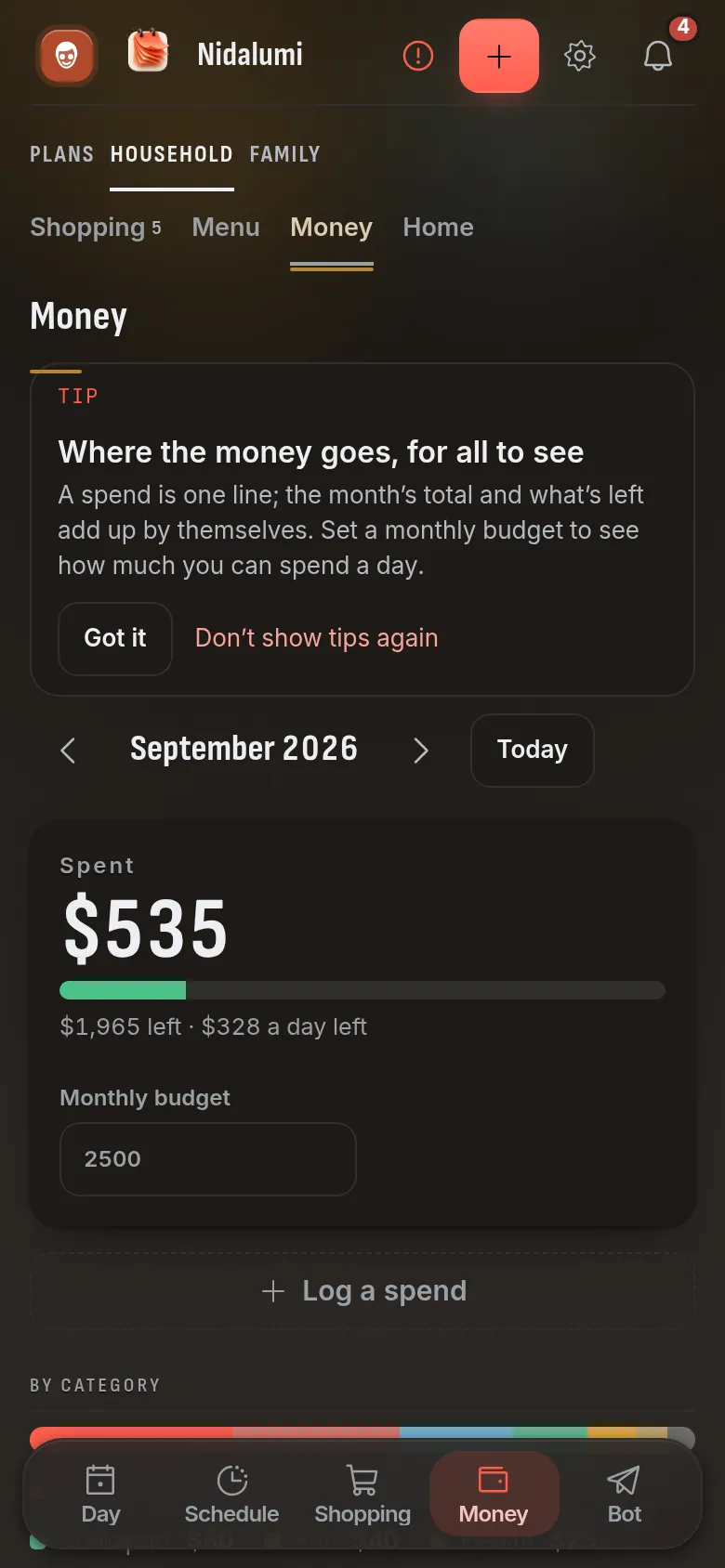
In Nidalumi money is one of the sections of the family planner, next to tasks, shopping and the schedule.
Spending. Logged as a single line — on the site, in the phone app or in the Telegram bot. The section is shared: the entry isn't in your private notes, it's where you're not the only one who sees it.
Recurring bills and subscriptions. Set up once, and from then on they remind you themselves. No more memorizing dates — the table above moves in here whole.
Goals. What the family is saving for: a vacation, a bike, home repairs.
Any currency. Dollars, euros, pounds — whatever you use.
Kids' money works separately: a child earns points for tasks and trades them for rewards or allowance, and the parent sets the rate. More in the article on allowance.
Questions and answers
Do we have to log every expense?
No. You can start with just the recurring bills and subscriptions: set them up once and get reminders. Add spending later, once you're used to it.
The other adult doesn't want to track anything. What do I do?
Don't ask them to "keep a budget." Agree on one action: spent something — wrote a line. That can be done in the Telegram bot too, without installing anything.
Can we track in a currency other than dollars?
Yes, any currency works.
How much does it cost?
5 days free, no card. After that it's $3.99 a month or $35 a year for a family of up to four — for the whole planner, not just the money section.