 Nidalumi
Birthdays and gifts: how to stop remembering it all alone
The dates, the ideas, who buys, who calls — all of it usually lives in one head. Here's how to move it into a shared list, when to start thinking about a gift, and a ready-made "who gives to whom" table.
Birthdays, gifts, who's giving what to whom — that's me too. Nobody notices until you forget. Forget once and they notice right away.
The short answer is three things:
- A shared list of dates that every adult in the family can see.
- A rule for when to start: three weeks out, not the night before.
- A name next to every date — who owns that gift from start to finish.
Each one is covered below, along with a table you can fill in tonight.
1. A shared list of dates
First, get the dates out of your head. One evening is enough.
Who goes on it:
- your own household: your partner, the kids, yourselves;
- parents and grandparents on both sides;
- brothers, sisters, nieces and nephews, godchildren;
- close friends — yours and the kids';
- anniversaries and the holidays when your family exchanges gifts.
Where to find the dates: scroll back through last year's calendar and messages, ask your parents, check the paperwork. If nobody remembers, ask the person — there's nothing embarrassing about it.
One rule: the list lives where every adult can see it, not in your phone. Otherwise you just move from the role of "I remember" to the role of "I check the list and remind everyone."
2. When to start thinking about a gift
Gifts don't go wrong because the date was forgotten. People remember the date — on the morning of the day itself. So the reminder needs to come early, not on the birthday.
| When | What to do |
|---|---|
| 3 weeks out | Come up with an idea: check the wish list or ask. Decide how much you're spending and who owns it |
| 2 weeks out | Buy or order it. Two weeks leaves room for shipping and for "it didn't fit" |
| 1 week out | The gift is in the house. Wrapping, a card. If there's a party, agree on the day and time |
| The day before | Check: gift, card, flowers. If you can't hand it over in person, decide how it gets there |
| On the day | Say happy birthday. Morning beats eleven at night |
None of this is science, just a household rule: three weeks is long enough for a package to arrive and short enough for the idea not to fade. For a custom gift or slow shipping, start a month ahead. For a card and a phone call, a reminder the day before will do.
3. Wish lists
The hardest part of a gift isn't buying it, it's thinking of it. You can spread that work over the whole year.
- Everyone has their own list. Kids write theirs happily; adults need to be asked — "so I don't give you a fifth scarf."
- Add to it when the person lets something slip. "A desk lamp would be nice" in February is a ready-made idea for October. If nobody writes it down, it's gone by October.
- Write down sizes: clothes, shoes, rings. And what not to give.
- Several options at different prices. Then you can share the list with grandparents and friends, and everyone picks something of their own.
- Mark who's taken what. Otherwise two identical building sets are only a matter of time.
For older relatives who answer "what would you like?" with "I don't need anything," the list is kept by whoever visits most: what broke, what's running low, what they've mentioned.
4. Who gives to whom
Usually this isn't divided at all — which means it landed on whoever starts worrying first. It works better to split by whole gifts, not by errands ("grab something for my mom"): think of it, buy it, wrap it, say happy birthday.
Rules that work:
- Each of you handles your own relatives and your own friends. All of it, card and phone call included.
- Gifts for the kids — take turns, or "one child, one adult." What matters is that there's a name.
- Birthdays of your kids' friends — decide once a year whose job that is. From a certain age the child picks the gift for a friend and the adult just pays.
- A group gift — one organizer, named out loud. "Somebody will collect the money" means nobody does.
- Gifts for each other are the one thing you can't hand off. Your partner's wish list does make life a lot easier, though.
Why "just tell me what to buy" doesn't take the weight off is covered in the article on the mental load.
A ready-made table
Copy it and fill in the "who" and "date" columns — that's already half the job.
| For | Date | Who owns it | Ideas | How much we spend | Where it stands |
|---|---|---|---|---|---|
| Dan's mom | March 14 | Dan | a throw blanket, a pool membership | to agree | idea |
| Emma, our daughter | June 2 | Kate | from her list: a scooter | to agree | ordered |
| Grandma Ruth | September 9 | Kate | a new lamp, a photo album | to agree | no idea |
| Noah, Leo's friend | October 21 | Dan and Leo | a building set | to agree | bought |
| Wedding anniversary | November 5 | both, for each other | — | — | — |
The "where it stands" column has four states: no idea → idea → bought → given. One glance shows where things are stuck, and nobody has to ask "did you buy it?"
Five minutes once a month is enough: look at what's coming in the next six weeks and check that every date has a name.
What usually breaks
- The gift gets bought twice, or by nobody. Fixed by the "who owns it" column.
- There was an idea and it got lost. Fixed by a wish list people add to on the spot.
- You remembered that morning. Fixed by a reminder three weeks out, not on the day.
- There's a list, but only one person looks at it. Fixed when the reminder goes to the owner, not to you.
Where to keep all this
A table on a sheet of paper works as long as someone remembers to look at it. Nidalumi has gifts and wish lists for this, and the birthday person can't see a surprise gift. "Buy a gift for Grandma Ruth" can be a task with a day and an owner — the reminder goes to them, not to you, and the task has a "Done" button. The party itself can go on the family calendar — it's shared by everyone.
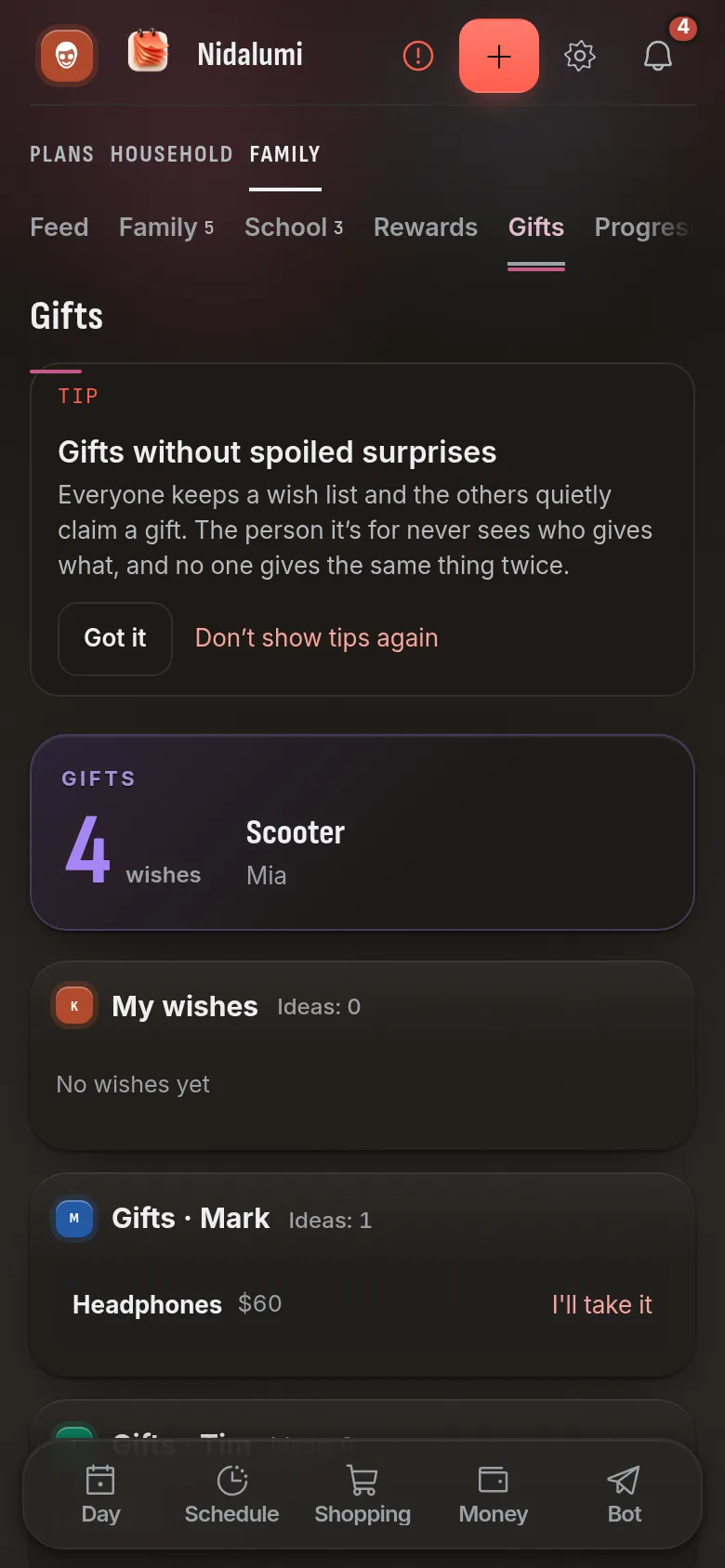
How it works in Nidalumi: Family Reminders.
Questions and answers
How far ahead should I start thinking about a gift?
A handy household rule is three weeks: a week for the idea, a week for buying or shipping, a week to spare. For custom gifts, a month.
How do we split who gives to whom?
The simplest way is for each of you to handle your own relatives and friends completely, from the idea to the happy-birthday call. Split the kids and mutual friends by name once and write it in the table.
What if the person answers "I don't need anything"?
Keep their list yourselves: note it when they mention something, when something of theirs breaks or runs low. Over a year a few ideas pile up.
How do we keep a wish list without spoiling the surprise?
The person writes what they'd like, and the others mark who's taken what — out of their sight. If you keep it on paper, keep the "who's giving" notes separate from the list itself.
How this guide was made: written by Christopher Clark, who builds Nidalumi. We update it when the advice changes.