 Nidalumi
Where is my kid: location on request, without tracking
You ask "Where are you?" and your kid taps "Share location" themselves. One point, for parents only, gone after 24 hours.
He hasn't answered for half an hour and I've already pictured everything. He was just on the bus, with his phone in his backpack.
The question "where is my kid" is almost never about a map. It's about those minutes when the message is unread, nobody picks up, and your mind is already spinning the worst. What you need isn't a dot crawling across a screen all day. It's a quick answer at one specific moment.
How it works
- A parent taps "Where are you?" on a child or teen.
- The kid gets a request. They tap "Share location" themselves.
- The parents see one point: where the kid is right now.
- After 24 hours the point is erased.
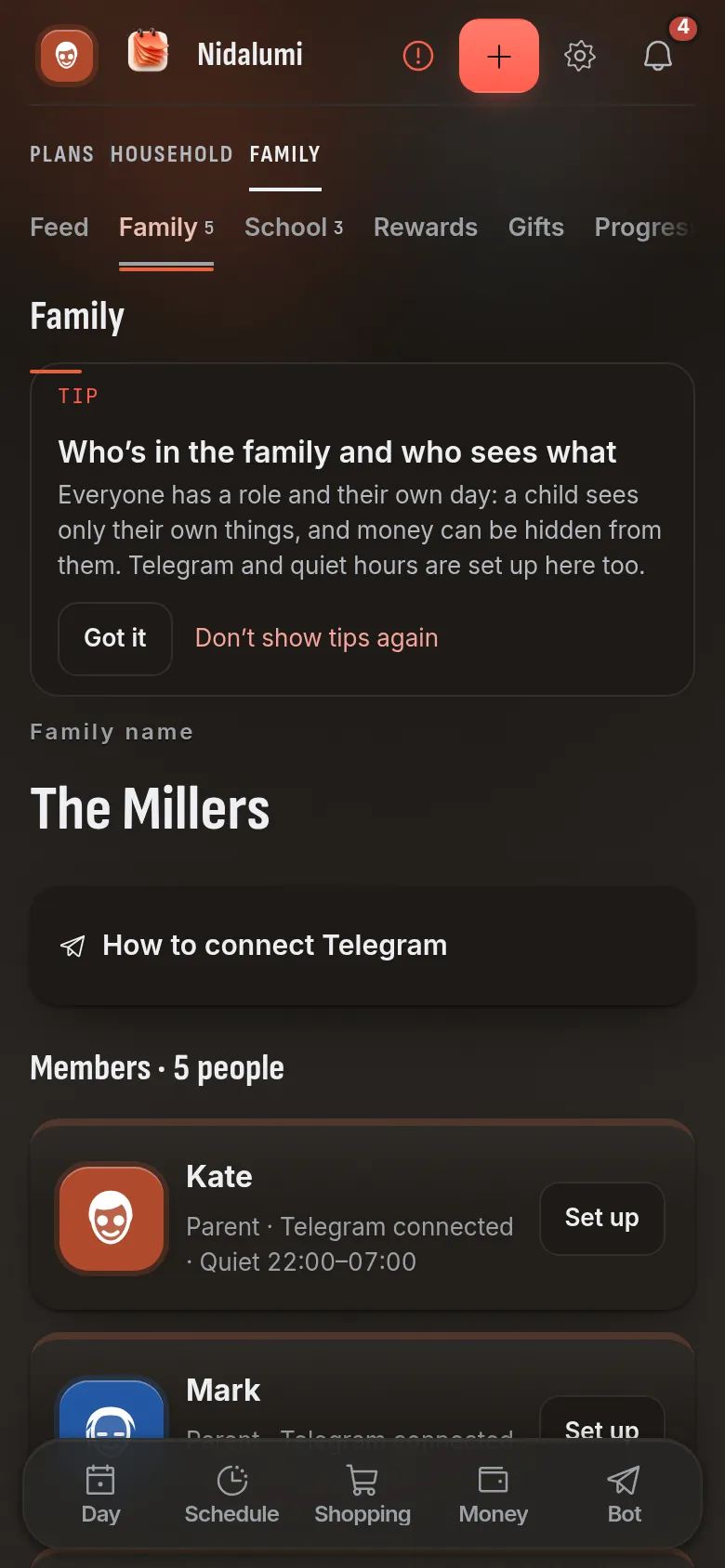
It works everywhere the rest of Nidalumi does: on the website, in the phone app and in the Telegram bot.
What's here and what isn't
| In Nidalumi | |
|---|---|
| Location at a parent's request | yes |
| Who sends the location | the kid, with a button |
| Who sees the point | parents only |
| How long it's kept | one point, 24 hours |
| A constant dot on a map | no |
| Movement history | no |
| Location without the kid knowing | no |
| SOS button | yes |
It's built this way on purpose. A location the kid sent themselves is an answer to a question, not surveillance. That's easier to agree on, especially with a teenager: they have nothing to hide and nothing to work around.
How to agree on it: rules you can take as they are
The button only works if you've agreed on it beforehand. Five minutes and three points are enough.
When a parent asks:
- a call or a message went unanswered;
- the kid is running later than agreed;
- a new route: first time going alone, a different way home, an unfamiliar neighborhood.
What the parent promises:
- not to ask every half hour "just in case";
- not to use the location as ammunition in an argument ("I know where you really were").
What the kid promises:
- to tap "Share location" as soon as they see the request;
- if plans change, to say so themselves without waiting to be asked.
What to say instead of interrogating
| Instead of | Try |
|---|---|
| "I need to know where you are every minute" | "I feel calmer when I know you got there. I'll only ask if you're not answering" |
| "Why aren't you picking up?!" | "If you can't talk, just tap 'Share location.' That's enough" |
| "I'm going to keep tabs on you" | "I can't see where you are until you send it yourself. And it's erased after a day" |
| "Where on earth are you?" | "I worry when you're running late. Let's agree on how you'll let me know" |
So you ask less often
Most of the worry isn't "where is he," it's "where is he supposed to be." When classes, clubs and practices are written into your kid's schedule, the answer is often there without asking: Tuesday, 5:00 p.m. means swimming.
The other half is reminders. If your kid gets their own reminder saying "leave for practice at 4:30," there are fewer "did you leave yet?" questions.
And there's an SOS button, so your kid can let you know themselves that they need help.
Questions and answers
Can I see where my kid is all the time?
No. The location arrives only at a parent's request and only when the kid has tapped "Share location" themselves. There is no constant tracking.
Will my kid know I'm asking?
Yes, always. The location isn't sent without their tap, and there is no tracking without the kid knowing.
Who else sees the location?
Only the parents. The point isn't shown to other family members.
How long is the location kept?
One point is kept. After 24 hours it's erased.
What happens if my kid doesn't respond to the request?
No location arrives. So it's worth agreeing ahead on what to do in that case: for example, call back in ten minutes.