 Nidalumi
The family meeting: 20 minutes a week instead of arguing on the run
A minute-by-minute agenda, the rules that keep a meeting from becoming a blame session, and what to do when "nobody has time." You could hold one this Sunday.
We really did sit down and divide everything up. Said out loud who does what. A week later — "wait, did we agree on that?" And it's all back on me.
Family meetings fail for two reasons. One: they get called when things have already boiled over — and you get a trial. Two: the decisions hang in the air and last a week. Below is a format that handles both: a short meeting on a schedule, and a record of who took what.
A 20-minute agenda
Set a timer. A meeting that drags on for an hour won't happen a second time.
| Minutes | Item | What happens |
|---|---|---|
| 0–2 | Good things this week | Everyone names one: what went well, what made them happy, who they want to thank |
| 2–7 | The week ahead | Who's going where and when. Activities, doctors, late nights, guests. Who drops off and who picks up |
| 7–12 | Household chores | What didn't work last week and what to change. Who needs cover this week |
| 12–17 | One question to decide | One, not five: where we're going this weekend, what to do about mornings, whether to buy the scooter |
| 17–19 | Something fun | Plan one thing to do together this week: a movie, baking, a walk |
| 19–20 | The recap out loud | The leader repeats: who took what and by which day. And it gets written down |
A few notes on the items.
"Good things" isn't a politeness ritual. It sets the tone: after two minutes of thank-yous, talking about the trash that didn't go out comes out calmer.
"The week ahead" is the most useful item. This is where it surfaces that Tuesday has two activities at the same time and nobody can pick up the youngest on Thursday. At the meeting that's a one-minute question; on Thursday at five it's a fight.
The "one question" is picked ahead of time. Keep a sheet on the fridge or a shared list: during the week anyone writes down what they want to discuss. Disputes don't get settled on the run — "put it on the list, we'll decide Sunday." That alone takes out some of the bickering.
The recap out loud can't be skipped. Without it, three days later everyone has their own version of what was agreed.
Four rules
1. It's not a blame session
The meeting is about next week, not last week. The test is simple: if a sentence starts with "you always…," it doesn't belong here. A different form works: "In the evenings the dishes sit until morning. What do we change?" You're discussing the setup, not the person.
2. Everyone gets a voice
People speak in turn, not by volume. Younger kids aren't interrupted or corrected. Where a decision affects everyone equally — where to go Saturday, what's for dinner on Sunday — you can vote, and a child's vote counts the same as an adult's.
3. Not everything goes to a vote
Say so honestly up front, or the kids will feel tricked. There are three kinds of questions:
| Kind of question | Examples | How we decide |
|---|---|---|
| We decide together | the weekend, the movie, the meal, a shared project | we vote |
| Adults decide, but listen first | who does which chores, screen rules, allowance | everyone has a say, the adults decide |
| Not for the meeting | safety, health, big expenses | adults decide on their own and explain |
4. Every decision gets a name and a deadline
Not "we should clear out the garage," but "garage — Dad, by Saturday." A decision with no owner gets done by no one. And it gets written where it'll be seen on Wednesday, not only on Sunday.
How to bring in the kids
Little ones only need the first item and the second-to-last: name a good thing and choose between two options — the park or the pool. Five minutes, then they can go play.
Elementary-age kids should get a real role. Leader with the timer is the favorite: you get to tell Mom "your time is up." And give them a real choice: not "do you agree to clean up?" but "what are you taking this week — dishes after dinner or the trash?"
Teenagers care most that what they say changes something. If a teen suggested it and it was adopted, they'll come next time. If they were heard out and you did it your way anyway, they won't. Sitting there stone-faced is allowed; demanding enthusiasm isn't needed. How to reach agreements at this age is in the article on teens and chores.
One thing for every age: the meeting is not the place where a child gets told off in front of everyone. Do that once and they'll be waiting for the catch at every meeting after.
When "nobody has time"
What meeting? We only manage dinner together twice a week.
Then don't carve out separate time for it — attach it to something that already happens.
- To a meal. Sunday breakfast or dinner, when everyone's at the table anyway. The meeting runs while you eat.
- A short 10-minute version. Just three items: the week ahead, one question, the recap out loud.
- Without one person. Someone's traveling or on a shift — hold it without them and send them the recap in writing. A canceled meeting stops happening faster than an incomplete one.
- The same spot in the week. "Sunday after breakfast" works; "sometime over the weekend" doesn't.
- Shorten, don't skip. In a rough week, five minutes by the door will do: who's going where and who's picking up whom.
The first two or three meetings will be awkward: someone says nothing, someone goofs off. That's a normal start. Don't drag it out, finish on time and on the fun item — that's what makes people show up more willingly next time.
Where to write the decisions down
A meeting creates an intention. For it to survive until Wednesday, the decision has to sit where everyone sees it and remind the person who took it, by itself. Otherwise you'll be the one reminding — and that's the very mental load the meeting was supposed to lift.
In Nidalumi what you decided becomes tasks: each task has its own person, the reminder goes to them, not to you, and in the evening there's a summary of the day — what got done and what didn't. The weekly schedule with activities and sports is shared and everyone sees it. "We decide together" questions go into the "Vote" section as polls — handy when getting everyone around the table didn't work out this week.
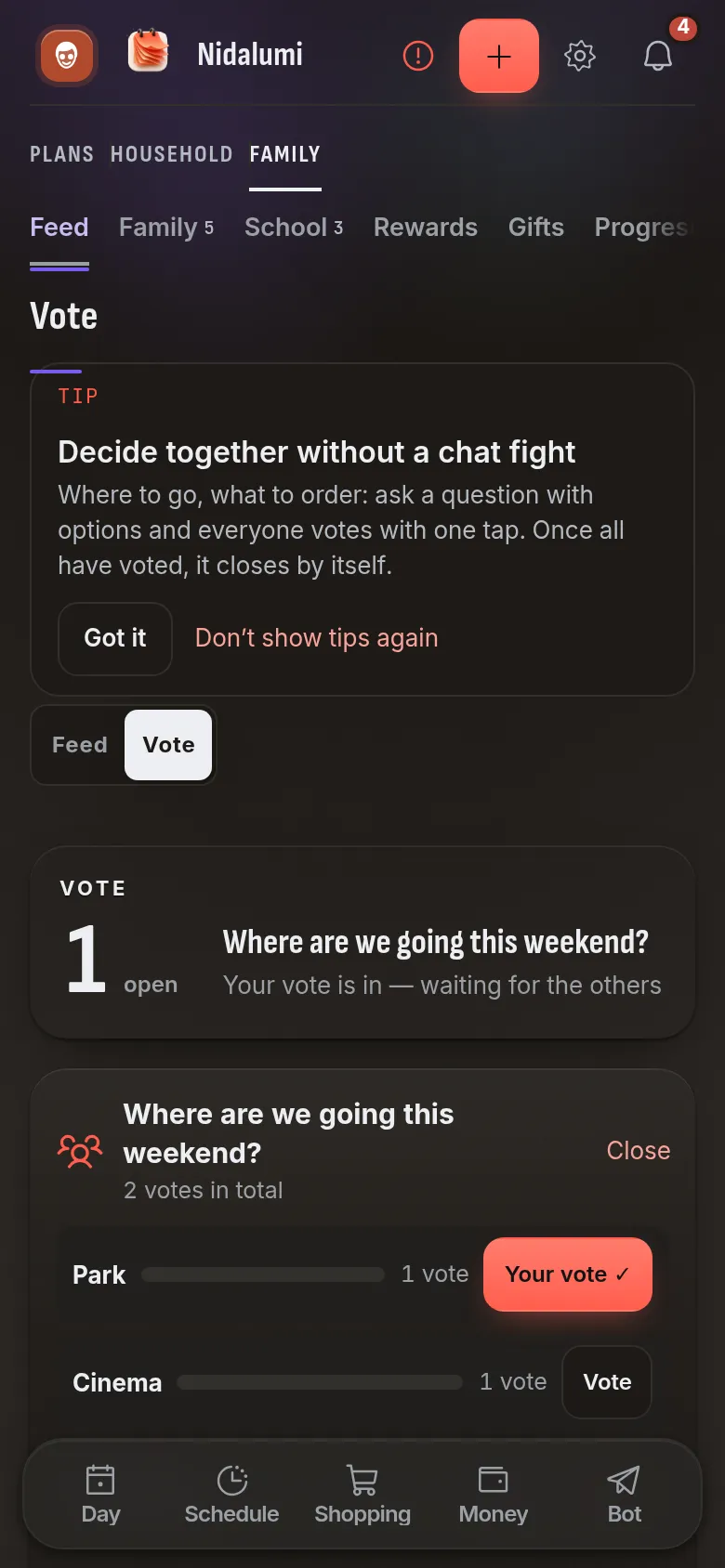
How it works in Nidalumi: Shared Family Calendar.
Questions and answers
How often should we hold a family meeting?
Once a week, on the same day and at the same hour. Less often and too much piles up, so the meeting turns into a blame session. More often usually isn't needed.
What if one of the adults refuses to take part?
Start with the short version and the practical item — "the week ahead." Ten minutes on who's picking up whom is useful to everyone and doesn't feel like a lecture. The rest can be added later.
At what age should kids join?
As soon as a child can choose between two options and wait for their turn to speak. For little ones, a few minutes at the start is enough.
The meeting turns into a fight. What's going wrong?
Most often someone brought a complaint about a person instead of a question about how the household runs, or you took on several topics at once. Go back to one question per meeting and to the "what do we change?" form.
Do we need to keep minutes?
Minutes, no. You need a short recap: what was decided, who took it and by which day. Three to five lines where the whole family will see them.
How this guide was made: written by Christopher Clark, who builds Nidalumi. We update it when the advice changes.