 Nidalumi
A morning without "hurry up and get dressed": getting your kid out the door without ten reminders
A calm morning is made the night before. Here's what to prep ahead, the order of steps, what your kid can run on their own, and what to say instead of "hurry up."
I say "get dressed" about fifteen times every morning. By the time we leave the house I'm wrung out, and the day hasn't even started.
Mornings don't fall apart because your kid is slow. They fall apart because forty minutes are crammed with decisions: what to wear, where the gym clothes are, what goes in the backpack, who signs the permission slip. Take the decisions out of the morning and only actions are left.
What to prep the night before
About fifteen minutes after dinner, before free time rather than right before bed:
- The backpack is packed for tomorrow's classes and sitting by the door.
- Clothes are laid out in one pile, the whole outfit, down to the socks. The choosing happens in the evening, so there's nothing to choose in the morning.
- Gym clothes and sneakers are in a bag next to the backpack.
- A snack and a water bottle are packed, or waiting on one shelf in the fridge.
- Signatures, notes, lunch money get handled tonight, not in the doorway.
- Breakfast is decided: what you're eating, with everything for it within reach.
- Keys, bus pass, phone on the charger are in one permanent spot.
- The alarm is set, and your kid has their own if they're old enough.
It helps to keep the evening list written down, by the door or on a phone. While it's in your head, you'll be asking the same questions in the evening that you used to ask in the morning.
A calm morning starts with enough sleep: 9–12 hours for ages 6–12, according to the American Academy of Sleep Medicine.
The morning, in order
The same every day. Kids find it easier to follow a familiar track than to be told what's next every time.
- Wake up with ten to fifteen minutes to spare beyond "just barely."
- Bathroom, wash up.
- Get dressed in what's in the pile.
- Breakfast.
- Teeth, hair.
- Shoes, jacket, backpack.
- Out the door at the same time every day.
Three rules that hold it together:
- Screens come after getting ready. Cartoons and phones only once your kid is completely ready, until it's time to go. A screen in the middle of getting ready stops everything.
- Leaving time is a number. Not "we're leaving soon" but "we're leaving at 7:40." With a clock or timer your kid can see.
- The order is posted where it's visible. Pictures for a little one, a list for a school-age kid. Then "what's next?" gets answered by the sheet, not by you.
If one step keeps getting stuck, move it. Some kids take half an hour to get dressed because they're not awake yet: let breakfast come first. The order has to fit your kid, not look correct.
How to hand your kid their part
You can't hand over the whole morning at once. You hand it over a step at a time, and your kid runs each step alone, without your "and now..."
| Age | What they run themselves | What stays with the adult |
|---|---|---|
| 3–5 | Gets dressed from the laid-out pile, as far as they can manage. Carries their own little backpack | Everything else. The morning order in pictures, and you point to "what's now" together |
| 6–8 | Gets up with an alarm. Gets dressed. Packs the backpack from a list in the evening | Breakfast. One look at the backpack in the evening. Leaving time |
| 9–11 | The whole morning from their own list. Backpack, gym clothes and outfit the night before | Breakfast and one reminder about the time |
| 12 and up | The entire morning, including the alarm and breakfast | An agreement on what time you leave, and what happens if they're late |
This is a rough guide: look at your kid, not at the number. Add one new step at a time and do it together at first. For what else your kid can handle, see the chart of chores by age.
And the hardest part: once a step is handed over, don't do it for them. A sweatshirt on inside out, sneakers forgotten once a month: that's the price of a morning that runs without you six months from now. You decide the exceptions: anything that truly can't be missed gets checked the night before.
What to say instead of "hurry up and get dressed"
"Hurry up" doesn't work because it doesn't say what to do. A time and a next step do.
| Instead of | Try |
|---|---|
| "Hurry up and get dressed!" | "We're leaving in ten minutes. What do you have left?" |
| "How long can this possibly take?" | "What's next on the list?" |
| "You didn't pack your backpack again!" | "Backpack gets packed in the evening. Tonight, right after dinner, first thing" |
| "We're going to be late because of you!" | "The timer's set for 7:40. When it goes off, shoes on" |
| "Just eat already!" | "Breakfast is until 7:30. Five minutes left" |
| "Wear what you're given!" | No debates in the morning. In the evening: "Blue or gray? Put it on the pile" |
| "Well, finally" | "You were ready before the timer. The five minutes left are yours" |
One principle: name the time and the step, not a verdict. Ask, don't order: a kid answers "what's left?" by doing it. And say it once: the second and third repeats teach that the first one can be ignored.
How to keep it going without reminding out loud
The morning is won by an evening reminder, and it's better when your voice isn't the one delivering it. In Nidalumi, "pack your backpack" is set up as your kid's task at the right time: the reminder goes to them, in Telegram or as a notification on their phone, and the task has a Done button. For a little one without a phone, a parent checks it off.
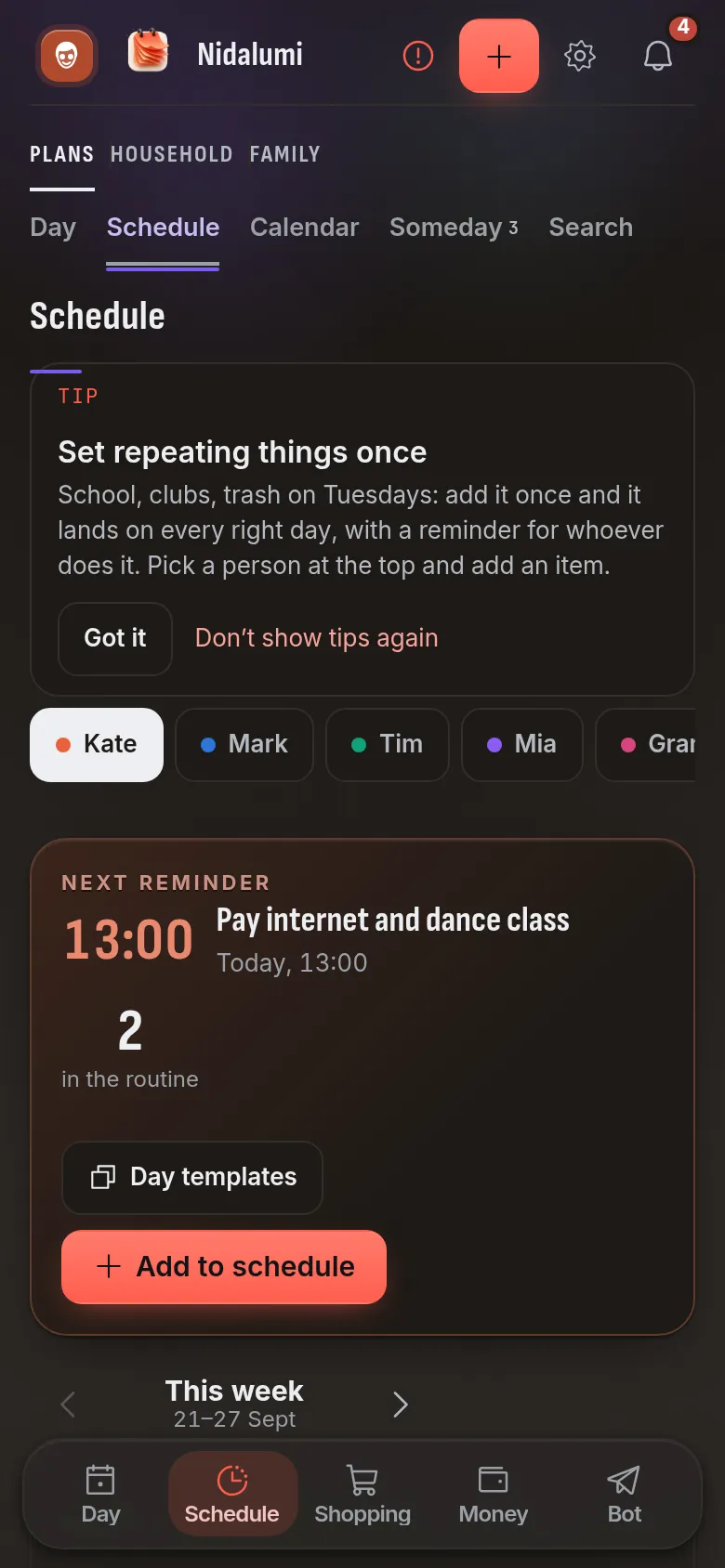
The weekly schedule (school, clubs, practices by day and hour) lives in one place for the whole family, so "what's happening tomorrow?" isn't a question for you. Anything recurring is set up once, as "Every week." For putting together the whole day, not just the morning, see the sample daily routine for a school-age kid.
How it works in Nidalumi: Kids' Schedule.
Questions and answers
How much time should I allow for the morning?
Count backward from leaving time: add up how long each step really takes your kid, then add ten to fifteen minutes of cushion. If you're short by the same chunk every morning, move the wake-up time instead of speeding up your kid.
My kid can't wake up. What do I do?
Start with the practical stuff: the alarm away from the bed, lights on, the same wake-up time every day. If your kid struggles to get up for weeks and looks short on sleep, that's a question for a doctor, not for a routine.
What if they still forget their gym clothes or a notebook?
If it isn't dangerous or critical, let them forget. One uncomfortable gym class without the gear sticks better than ten reminders. Then in the evening, go back to the prep list and see what's missing from it.
What if I have two kids and they get in each other's way?
Separate them by time or place: one washes up first while the other eats, then they switch. Each has their own list and their own pile of clothes. And one leaving time for everyone.
Is it okay to reward a morning with no lateness?
Yes, if it suits your family. But reward their part rather than speed: backpack packed the night before, dressed before the timer. A reward for a specific step is clearer than one for "a good morning."
Sources
How this guide was made: written by Christopher Clark, who builds Nidalumi. Figures and health or money facts are checked against the sources listed in the guide. We update it when the advice changes.