 Nidalumi
Family chore rotation: a chore chart that runs itself
Whose turn it is to take out the trash and do the dishes tonight is something the rotation knows, not you. Below: which chores to put in it, four rules, and how to keep a chart nobody has to maintain by hand.
"Take out the trash." "It's not my turn." "Whose is it, then?" — and now we're not arguing about the trash, we're arguing about who remembers what.
A paper chore chart on the fridge doesn't last long, and laziness isn't the reason. It's silent: it doesn't remind anyone, doesn't know yesterday's turn was skipped, and doesn't remember who swapped with whom. One person has to keep an eye on it — the same person who used to just remind everyone out loud.
A chart that works differs in one thing: no human is running the rotation.
Which chores to rotate
The rotation is for chores that repeat, that any of the people in it can do, and where it's clear what "done" means.
| Chore | How often | Who's in the rotation | What "done" means |
|---|---|---|---|
| Take out the trash | every evening | adults and older kids | bag out, new bag in |
| Dishes after dinner | every day | adults and the teenager | sink empty, table wiped |
| Evening dog walk | every day | everyone who walks the dog without an adult | walked, paws cleaned |
| Vacuuming | Saturdays | the whole family | every room and the hallway |
| Water the plants | once a week | younger kids | every pot, the balcony too |
This is an example — put in your own people and your own frequency.
Not everything should go around in a circle. A chore that's tied to someone's schedule, or that one person clearly minds less than the others, is better given to them outright — see the article on how to split household chores.
Four rules of a rotation
- By name, not "whoever's free." "Somebody will take it out" means you will.
- One chore, one rotation. A general "on house duty" chart is too big: nobody knows what it covers. Trash gets its own rotation, dishes get theirs.
- "Done" is spelled out in advance. That's what the last column of the table is for: without it the argument moves from "whose turn" to "you call that clean?"
- Swapping is fine, skipping isn't. Everyone has practices and late shifts. A swap is a normal part of the chart, as long as both people know about it and it's written down somewhere.
How it works in Nidalumi
In Nidalumi a rotation is a queue of people attached to a chore.
The rotation passes the chore to the next person by itself. Nobody counts who went yesterday or redraws the chart for the new week.
It reminds the person on duty, not you. The message goes to whoever's turn it is today — in Telegram or as a notification on their phone. Your voice isn't involved, so there's nothing to snap back at.
You can swap. Can't do it today? Swap, and the rotation remembers. "Didn't we swap?" is no longer settled from memory.
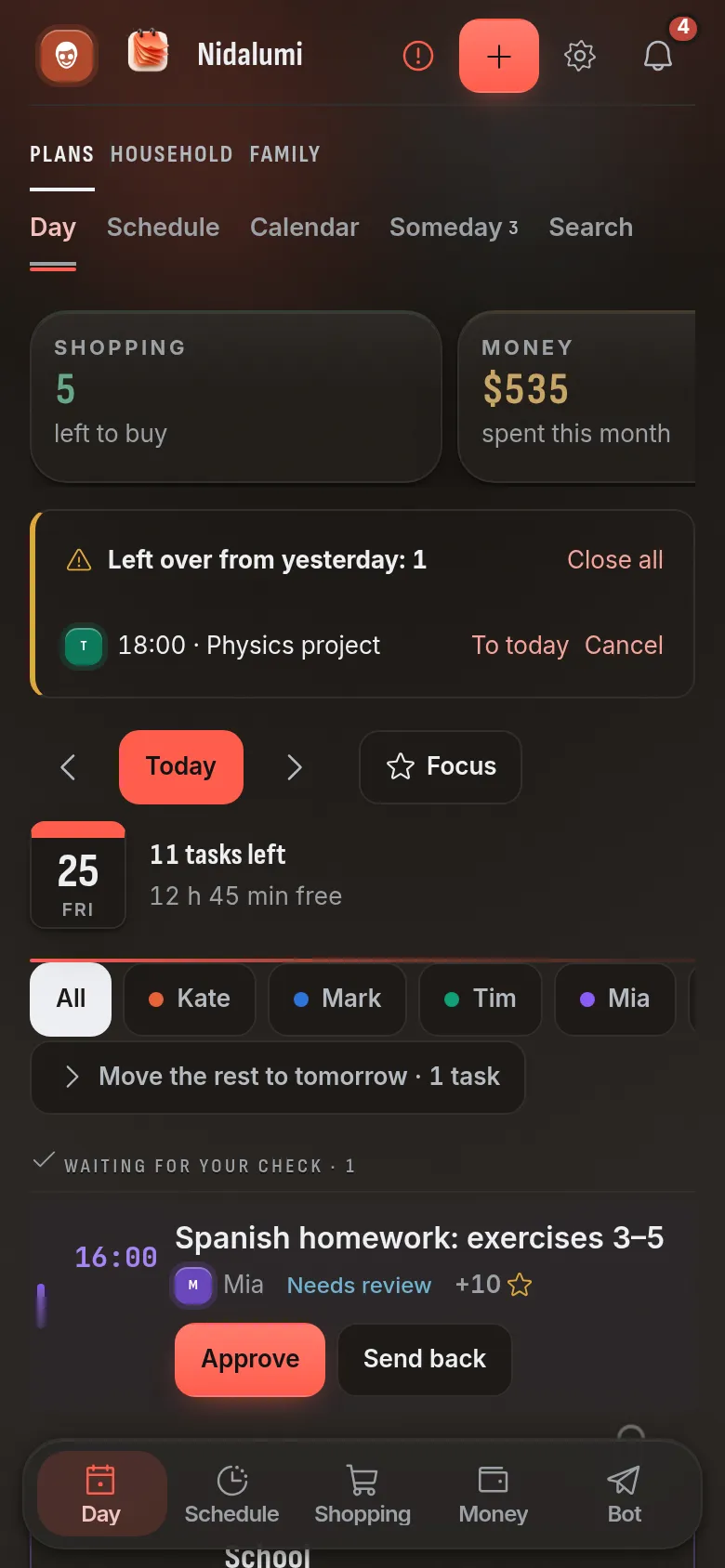
You can see whether it's done. The chore has a "Done" button. In the evening a summary of the day arrives: what got done and what didn't. What's not done doesn't get hidden — and you don't have to ask "did you take it out?"
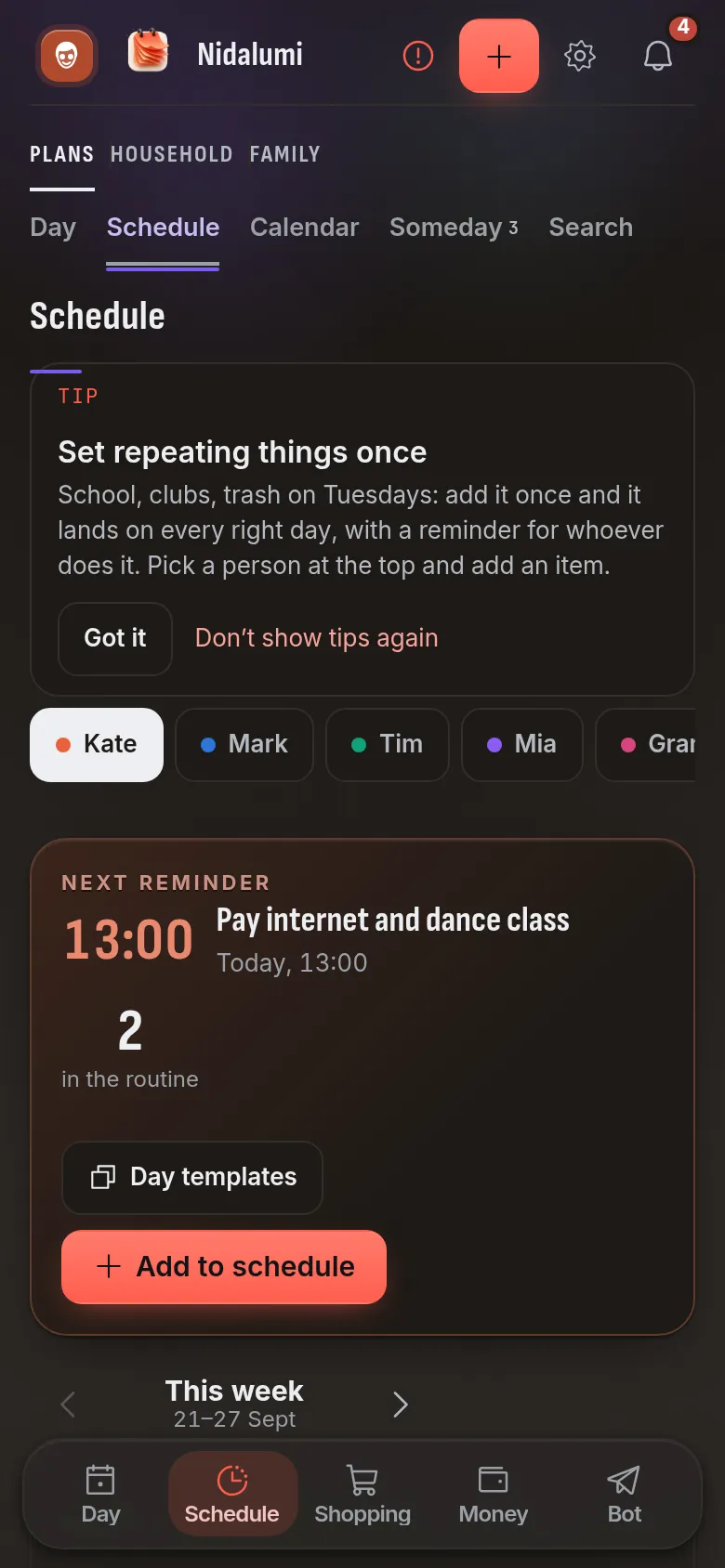
Kids — with a check and points. The child taps "Done," the chore goes to "Waiting for your check," the parent approves. Chores earn points that can be traded for rewards. Which chores suit which age is in the chores by age list.
A chart on the fridge vs. a rotation: the difference
| Chart on the fridge | Rotation in Nidalumi | |
|---|---|---|
| Who keeps track of turns | whoever made it | the rotation itself |
| Reminder | none, or your voice | to the person on duty, on time |
| A swap | said out loud, argued about later | recorded, the rotation remembers |
| Done or not | you have to ask | shown in the evening summary |
| A new week | redraw it | it just carries on |
Where to start
- Pick the one chore you remind people about most. It's usually the trash or the dishes.
- Build the rotation by name and agree on what "done" means.
- Go a week without reminding out loud — check the evening summary instead.
One rotation that survives a week without your reminders convinces the family better than any talk. Then add a second one.
Questions and answers
How do we make a chore rotation that's fair?
Only rotate chores that every person in the rotation can do, and pass them around one at a time. Chores that don't fit someone's age or schedule go to a specific person and get counted separately.
What if the person on duty doesn't do it?
The chore stays undone and shows up in the evening summary — everyone can see it, no interrogation needed. The family decides what's next: finish it tomorrow, swap, or talk about whether this chore suits the person.
Can kids be in the rotation?
Yes. The child marks the chore with the "Done" button and a parent checks it. For a small child without a phone, a parent marks it.
Does everyone need to install an app?
No. The reminder with its button can arrive in Telegram, or you can use the site in a browser or the app on a phone — whatever suits each person.