 Nidalumi
Back-to-school checklist, week by week
Back-to-school prep doesn't fall apart because you're forgetful. It falls apart because everything comes to mind in the last week. Here's what to do four weeks out, three, two, one, and on the last day. And who does it.
I forgot to sign my kid up in time and the spot was gone. Nobody said a word to me, and I still remember it.
Spread the prep over four weeks and each week holds two or three jobs, not thirty. Here's the whole list.
The checklist by week
| When | What to do | Who |
|---|---|---|
| 4 weeks out | Find out which forms the school needs before the year starts. Book a doctor's visit if a health form is required. Find out when sign-ups open for activities and sports | the adult who owns "school and paperwork" |
| 3 weeks out | Try on school clothes, shoes and gym gear. Check the backpack, pencil case and gym shoes. List what's missing. Buy clothes and shoes | the other adult and the child |
| 2 weeks out | Buy supplies from the list. Sign up for activities. Start shifting wake-up and bedtime. Put the weekly schedule together | the child with an adult |
| 1 week out | Walk the route to school. Set up a homework spot. Label everything. Decide who does drop-off and pickup on which days | everyone together |
| The last day | Clothes on the chair, backpack by the door, alarm set, breakfast planned. Bed on time | the child, an adult checks |
Now each part in more detail.
4 weeks out: forms and sign-ups
This is the part that depends on other people's calendars, not yours: the school, the doctor's office, the sports club. So it goes first.
- Call the school or check the class emails: what needs to be turned in before the year starts. Forms, health records, photos, the lunch account — every school has its own list, so don't guess.
- If a health form is required, book the doctor now. Appointments get harder to find as the first day gets closer.
- Activities and sports: when sign-ups open, which days practice falls on, whether a form or a uniform is needed. Spots go fast — set yourself a reminder for the day sign-ups open.
- Put all the school paperwork in one folder. Not "somewhere in a drawer."
3 weeks out: inventory, clothes and shoes
Check first, shop second. Otherwise you end up with a third pencil case and no gym shoes.
- Your child tries on everything: school clothes, gym clothes, everyday shoes and sneakers. Kids grow over the summer.
- Check the backpack (zippers, straps), the pencil case, the lunch box, the water bottle.
- Write a shopping list: one line, one item.
- Buy clothes and shoes. These are worth getting early: the right size is harder to find at the end of summer, and you'll still have time to exchange.
2 weeks out: supplies, activities, sleep schedule
- Supplies — from the teacher's list, if there is one. No list? Buy the basics: notebooks, pens, pencils, a ruler, an eraser. You'll pick up the rest in the first week, once it's clear what's actually needed.
- Sign up for activities and put them straight into the weekly schedule: day, time, who drives. How to build a week that actually fits into your life is on the kids' schedule page.
- Sleep schedule. After the summer, kids go to bed late and get up late. Shift wake-up and bedtime a little at a time, 15 minutes every couple of days — that way mornings stop being a battle by the first day.
1 week out: the route, the homework spot, the agreements
- Walk the route to school at the time your child will actually be going. Where to cross, where the bus stops, how long it takes. If they'll go alone, do it twice: once with you, once as "you lead, I follow."
- Who drops off and who picks up — by day of the week, with names. Not "we'll figure it out."
- The homework spot: a desk, a lamp, a shelf for books, a place for the backpack.
- Label everything: gym shoes, gym clothes, the lunch box, the water bottle.
- What your child carries: keys, a bus pass, your number on a slip of paper in the backpack.
- Rehearse the morning: get up to the alarm once and get ready like it's a school day. More on that in a morning without reminders.
The last day
- Tomorrow's clothes are on the chair, all of them, socks included.
- The backpack is packed and sitting by the door.
- Anything the teacher asked for on day one is already in the bag.
- The phone is charged, the alarm is set.
- Breakfast is decided the night before.
- Bedtime is the one you've been working toward for two weeks.
How to split the prep between the adults
The worst setup is one person remembering everything while the other "helps when asked." It works better to split by whole areas instead of single errands: the person finds out, decides and does it themselves.
| Area | What's in it |
|---|---|
| School and paperwork | forms, health records, class emails, the lunch account |
| Clothes and shoes | trying on, the list, buying, exchanging, labeling |
| Activities and sports | sign-ups, the schedule, the uniform, who drives |
| Supplies and the homework spot | the list, the shopping — together with the child |
| Getting there | the route, the bus pass, keys, who drops off and picks up |
Five areas, two adults: split them however suits you, but every area needs a name on it. An area with no name goes to whoever thinks of it first — which means you.
What to hand over to your child
Getting ready for school is their job too. The more they do themselves, the less you'll be reminding in the fall.
- Younger kids: try things on and say what's too small; pick a pencil case and folders; sort the supplies; pack the backpack from a list; lay out clothes the night before.
- Ages 9–12: write their own list of what's missing; buy supplies from the list with an adult; copy down the class schedule; tidy the desk; set their own alarm.
- Teens: run their whole part — supplies, schedule, signing up for a sport, the route. Your role is to ask what they need from you and hand over the money for the shopping.
Once the school year is underway
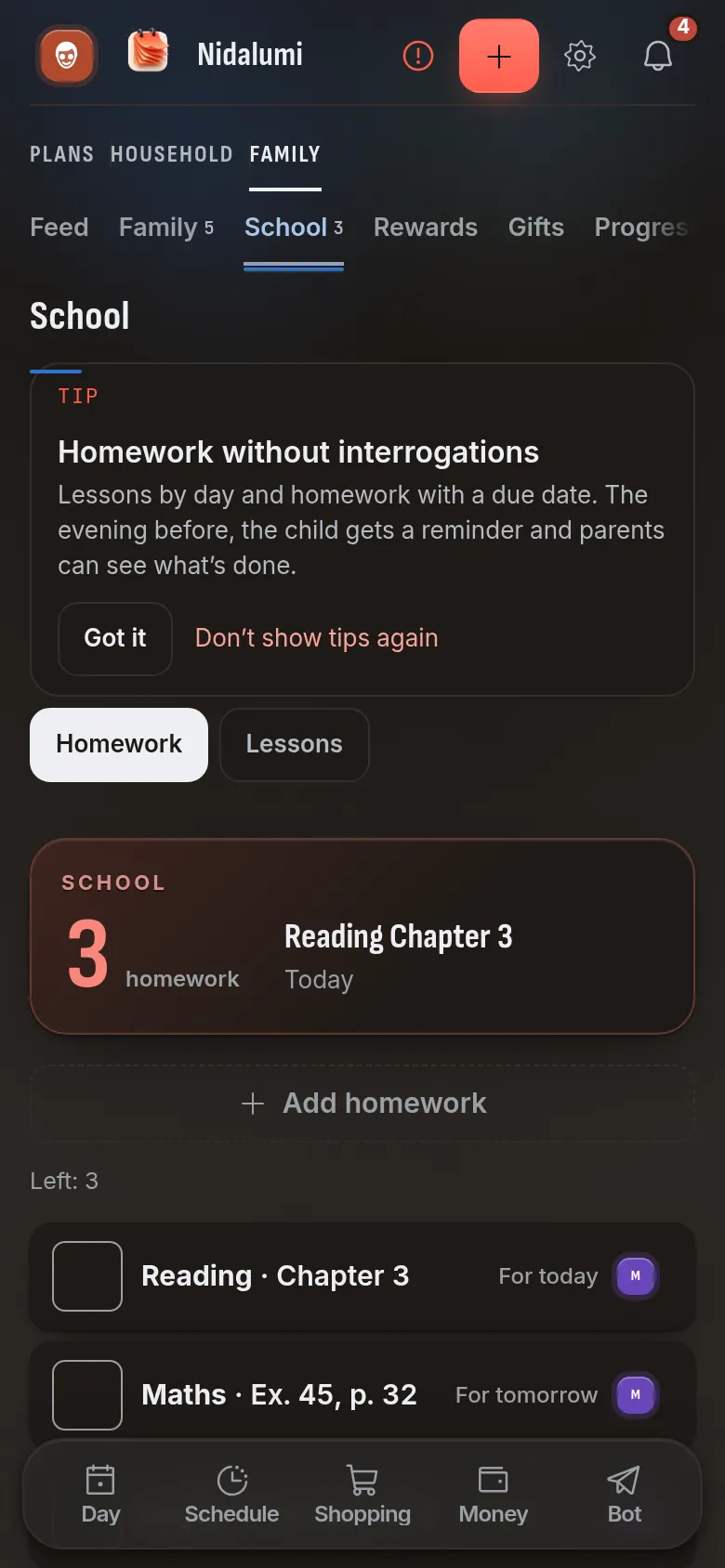
The checklist ends on the first day of school, but the schedule stays for nine months. In Nidalumi you set up school, activities and sports by day and hour once — "Every week" — and the whole family sees them. The reminder goes to whoever the job is assigned to: dance pickup to one adult, packing the backpack to the child. School shopping sits in the shared list, and each item can say who's buying it.
Questions and answers
School starts in a week. Where do I begin?
With whatever depends on other people: forms, health records, activity sign-ups. Then clothes and shoes. Supplies can be kept to the basics and topped up during the first week of school.
What should I buy ahead, and what can wait until school starts?
Ahead — clothes, shoes, the backpack and whatever is on the teacher's list. After — anything you're not yet sure you need: extra notebooks, folders, gear for activities.
How do we get back on a sleep schedule after the summer?
Gradually: shift wake-up and bedtime by 15 minutes every couple of days, starting two weeks out. And live through at least one morning like a school day — alarm, getting ready and all.
What's different when a child is starting school for the first time?
More questions for the school and more rehearsals: walk the route, show them where the classroom and the cubbies are, practice packing the backpack and the morning. The list of things is almost the same — just confirm it with the teacher.
How this guide was made: written by Christopher Clark, who builds Nidalumi. We update it when the advice changes.